
As organizations increasingly rely on the cloud for innovation and scalability, a new challenge has emerged: spiraling cloud costs. Without a clear strategy, cloud spend can quickly become unpredictable and unsustainable, eating into budgets that could be used for growth. The solution isn’t to stop innovating, but to optimize. This guide provides a comprehensive framework for effective cloud cost optimization, blending actionable strategies, a cultural shift towards financial accountability, and the right tools to automate success.
By mastering these principles, you can transform your cloud infrastructure from a major cost center into a strategic, cost-effective asset that drives business value. We will explore how to find and eliminate waste, build a culture of cost-consciousness, and leverage automation to maintain control.
Table of Contents
- Why Cloud Cost Optimization is a Business Imperative
- The FinOps Framework: Building a Culture of Cost Accountability
- 7 Actionable Cloud Cost Optimization Strategies
- Leveraging Native and Third-Party Automation Tools
- Common Challenges in Managing Cloud Costs
- Frequently Asked Questions
Why Cloud Cost Optimization is a Business Imperative
Effective cloud cost management is more than just a line item on a budget; it’s a critical business function that directly impacts profitability and the pace of innovation. In a competitive landscape, organizations that manage their cloud resources efficiently gain a significant advantage.
Beyond Savings: Improving ROI and Fueling Innovation
Every dollar saved on unnecessary cloud spend is a dollar that can be reinvested into core business activities. Optimizing costs improves the Total Cost of Ownership (TCO) and Return on Investment (ROI) of your cloud initiatives. This financial freedom allows you to fund new projects, hire talent, or accelerate your product roadmap without seeking additional budget approvals.
The High Cost of Inaction: How Cloud Waste Erodes Budgets
Cloud waste, which includes overprovisioned servers, idle resources, and unattached storage, can cripple budgets. According to industry benchmarks like the Flexera State of the Cloud Report, organizations estimate a significant portion of their cloud spend is wasted. Inaction leads to budget overruns, strained financial planning, and a reactive, chaotic approach to cost management. Proactively addressing this waste is fundamental to achieving financial stability in the cloud.
The FinOps Framework: Building a Culture of Cost Accountability
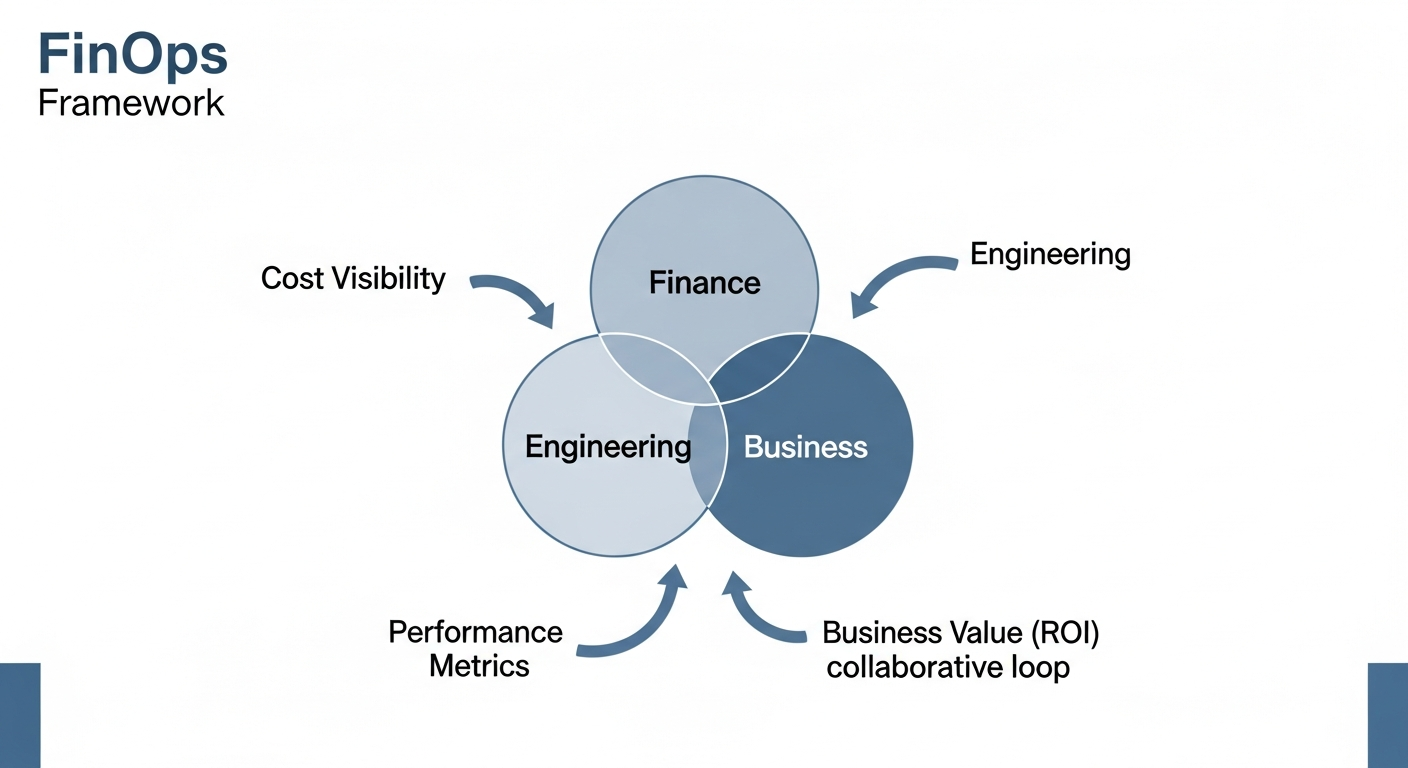
True cloud cost optimization requires more than technical fixes; it requires a cultural shift. The FinOps framework provides a model for implementing this change, creating a shared sense of ownership over cloud spending across the entire organization.
Core Principles of FinOps
FinOps is an operating model that brings financial accountability to the variable spending model of the cloud. Its core principles include making teams collaborate, driving business value from cloud spending, and making cost-aware decisions in near real-time. The goal is to get the most value out of every dollar spent, not just to reduce the bill.
Bridging the Gap Between Engineering, Finance, and Business Teams
Traditionally, engineering teams focused on performance, while finance teams focused on budgets, often creating friction. The FinOps framework breaks down these silos. By providing engineers with visibility into the cost implications of their architectural decisions, they become empowered to build more cost-efficient systems from the start.
A key strategy in implementing FinOps is to treat cloud cost as a first-class metric, just like performance or security. When engineers see cost data alongside their application monitoring, they naturally start to innovate on efficiency.
This collaborative approach ensures that technical goals are aligned with financial objectives, leading to more sustainable and predictable cloud spending.
7 Actionable Cloud Cost Optimization Strategies
With a FinOps culture in place, you can begin implementing specific technical strategies to reduce cloud spend. These tactics range from simple clean-up tasks to more complex architectural adjustments, each offering significant savings potential.
1. Rightsizing: Match Infrastructure to Actual Workload Needs
Rightsizing is the process of analyzing performance data and modifying overprovisioned instances to better match their actual workload requirements. It is one of the most effective ways to cut costs.
A common mistake is to focus only on CPU utilization when rightsizing. Always analyze both CPU and memory metrics over a period that includes peak business activity (e.g., month-end) to avoid creating performance bottlenecks.
2. Autoscaling: Dynamically Adjust Resources to Meet Demand
Instead of provisioning for peak traffic 24/7, autoscaling allows you to automatically increase or decrease resources based on real-time demand. This ensures you have the performance you need during busy periods while saving money during quieter times.
Experienced developers set conservative scaling thresholds. If your scale-up and scale-down triggers are too sensitive, you can cause ‘thrashing,’ where instances are constantly being created and destroyed, potentially increasing costs and instability.
3. Scheduling: Power Down Non-Production Environments
Development, testing, and staging environments often don’t need to run outside of business hours. Implementing automated schedules to shut down these resources can lead to immediate savings. For example, you can use services like AWS Instance Scheduler or Azure Automation to create custom start/stop schedules for your EC2 and VM resources.
4. Storage Optimization: Implement Tiering and Cleanup Policies
Not all data needs to be stored on high-performance, expensive storage. Use storage tiering to move infrequently accessed data to cheaper alternatives like AWS S3 Glacier or Azure Archive Storage.
Getting Started with Storage Cleanup:
- Run a report to identify unattached EBS volumes or Azure disks older than 30 days.
- Implement lifecycle policies in AWS S3 or Azure Blob Storage to automatically transition data to colder tiers.
- Tag snapshots with clear retention policies to automate the deletion of outdated backups.
5. Commitment-Based Discounts: Leverage RIs and Savings Plans
For stable, predictable workloads, cloud providers offer significant discounts. According to official AWS and Azure documentation, you can reduce compute costs by up to 72% compared to on-demand pricing in exchange for a one or three-year commitment.
Reserved Instances vs. Savings Plans: What’s the Difference?
Choosing the right commitment model is crucial. Here’s a quick comparison:
- Reserved Instances (RIs): Offer the highest discount but are less flexible. You commit to a specific instance family, region, and operating system. They are ideal for truly static workloads where you can predict your needs precisely.
- Savings Plans: Offer slightly lower discounts but provide much more flexibility. You commit to a certain amount of hourly spend (e.g., $10/hour) which applies across different instance families, and even across services like AWS Fargate and Lambda. They are best for dynamic environments where instance types may change.
6. Waste Identification: Hunt Down Idle and Unattached Resources
Actively search for and eliminate cloud waste. This includes zombie assets like idle load balancers, unattached IP addresses, and virtual machines that are running but have zero utilization. These resources often accumulate over time and contribute silently to a bloated cloud bill.
7. Re-architecting for Efficiency
For long-term optimization, consider re-architecting parts of your application to use more cost-effective cloud-native services. This could involve breaking down a monolithic application into microservices or replacing a constantly running server with a serverless solution like AWS Lambda or Azure Functions, where you only pay for the compute time you consume.
Leveraging Native and Third-Party Automation Tools
To overcome optimization challenges at scale, organizations use a combination of native cloud tools and specialized third-party platforms.
Using Native Cloud Tools for Optimization
Before looking at external solutions, it’s essential to maximize the tools your cloud provider offers. Services like AWS Cost Explorer provide detailed reports on your spending, while AWS Compute Optimizer and Azure Advisor use machine learning to offer specific recommendations for rightsizing instances and identifying idle resources. These tools provide a solid foundation for any cost management strategy.
Accelerating Optimization with a Centralized Platform
While native tools are powerful, they can be siloed. A dedicated cloud cost management platform ingests and normalizes billing data from multiple clouds, presenting it in a single dashboard. This provides the centralized visibility needed to manage multi-cloud environments effectively and supports the FinOps model by giving every stakeholder—from a DevOps engineer to a CFO—access to the cost data they need to make informed decisions.
Common Challenges in Managing Cloud Costs
Despite knowing the strategies, many organizations struggle with implementation due to several common hurdles. Overcoming these challenges is key to sustained success.
Challenge 1: Lack of Granular Visibility
Native cloud billing tools can be complex and may not provide the granular, tag-based cost allocation needed to understand which teams, projects, or features are driving spend. Without this visibility, it’s impossible to hold teams accountable.
Challenge 2: Decentralized Ownership and Accountability
In a decentralized cloud environment, engineers can spin up resources without understanding the cost. When no one feels direct ownership of the bill, there is little incentive to be frugal, leading to a “tragedy of the commons” scenario.
Challenge 3: The Manual Effort of Continuous Optimization
Cloud environments are dynamic. A perfectly rightsized instance today might be overprovisioned tomorrow. Manually monitoring thousands of resources continuously is an impossible task, leading to optimization decay over time.
Frequently Asked Questions
What is the first step in cloud cost optimization?
The first step is gaining full visibility into your current cloud spend. You cannot optimize what you cannot see. Understanding where your money is going across different services, projects, and teams is the foundational requirement for any successful optimization effort.
How does FinOps differ from traditional cost management?
Traditional cost management is often a centralized, reactive process led by finance. FinOps is a decentralized, proactive cultural practice that empowers engineering teams with the data and tools to make cost-aware decisions in real-time, fostering collaboration between technology and finance.
What is the most common form of cloud waste?
Overprovisioning, or ‘rightsizing,’ is one of the most common and significant forms of cloud waste. This occurs when teams allocate more powerful and expensive resources (e.g., CPU, memory) than an application actually requires, leading to paying for unused capacity 24/7.
Can cloud cost optimization be fully automated?
While many aspects of cloud cost optimization like identifying idle resources, recommending rightsizing, and executing schedules can be automated, the strategic decisions—like purchasing Reserved Instances or setting budget policies—still require human oversight. Automation handles the tactical work, freeing up teams to focus on strategy.
Embarking on a cloud cost optimization journey is a continuous process, not a one-time project. By combining a cultural commitment to FinOps with powerful strategies and intelligent automation, you can take definitive control of your cloud spend, enhance your ROI, and build a more efficient, innovative, and financially sound organization.