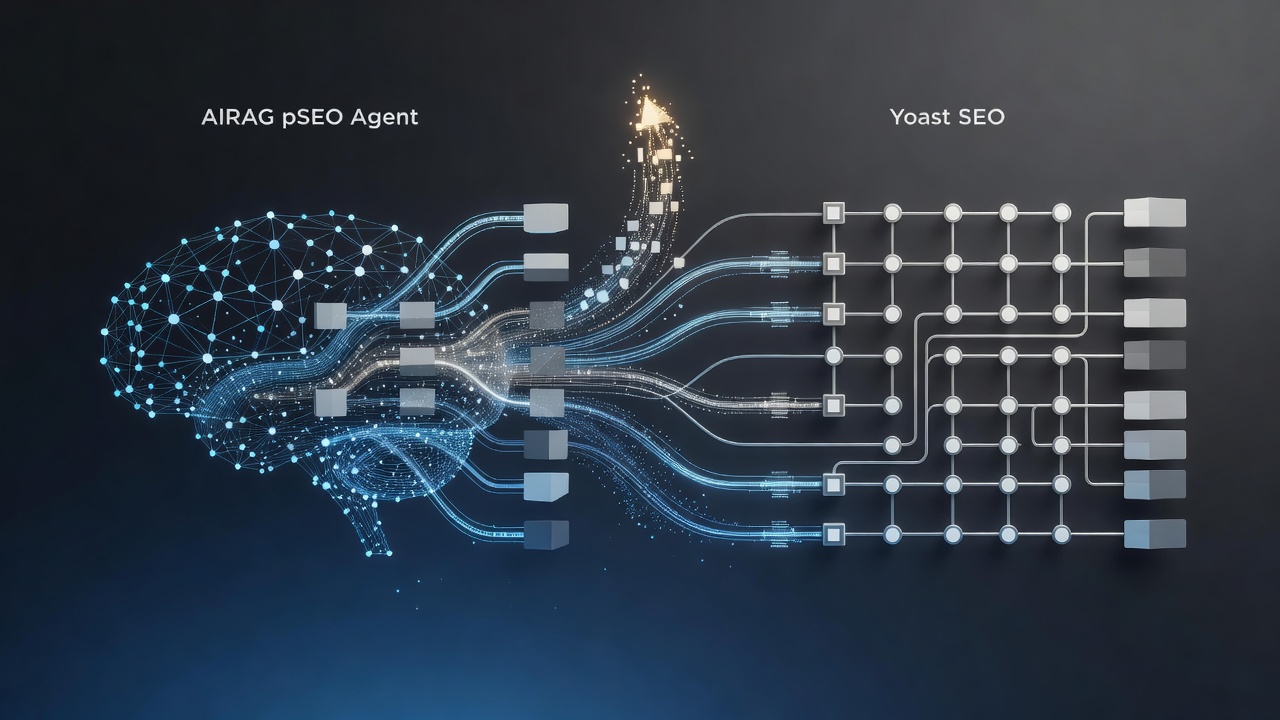

In the rapidly evolving landscape of digital marketing, the line between content creation and search engine optimization has all but disappeared. As of 2026, businesses face a critical choice: should they adopt tools that automate content production or double down on tools that optimize human-led efforts? This question brings us to a head-to-head comparison of two industry powerhouses: AIRAG pSEO Agent vs Surfer SEO. While both aim to help you dominate the SERPs, they approach the challenge from fundamentally different philosophies.
This definitive pillar post will dissect every aspect of these platforms, from their core AI technology and strategic workflows to ideal user profiles and the crucial question of future-proofing your business against the next wave of AI-driven search. We will move beyond a simple feature list to explore real-world scenarios, common pitfalls, and the technical underpinnings that define these tools, giving you the expert insight needed to make a truly informed decision.
Table of Contents
- Core Philosophy: Autonomous Creator vs. Guided Optimizer
- At a Glance: Feature & Philosophy Matrix
- Technical Deep Dive: RAG vs. Correlational SEO
- Deep Dive: AIRAG pSEO Agent’s Generative AI Powerhouse
- Deep Dive: Surfer SEO’s Optimization & Analysis Toolkit
- Use Case Scenarios: A Day in the Life
- Building Topical Authority: A Strategic Comparison
- Limitations and Considerations: Where Each Tool Falls Short
- Integration & Workflow: WordPress-Native vs. Platform-Agnostic
- Beyond Content: Support, Community, and Onboarding
- Pricing Models in 2026: Investment vs. Expense
- The Verdict: Which SEO Tool is Built for the Future of Search?
- Frequently Asked Questions
Core Philosophy: Autonomous Creator vs. Guided Optimizer
The primary difference between AIRAG pSEO Agent and Surfer SEO is that AIRAG is an autonomous content creator that generates complete, brand-aligned articles from scratch, while Surfer SEO is a content optimizer that provides data-driven guidance to improve human-written articles. This distinction in purpose is the most critical factor in choosing between them.
AIRAG pSEO Agent: Your On-Brand, Automated Content Creator
AIRAG pSEO Agent operates as an all-in-one AI Content Engine built directly into WordPress. Its core function is autonomous generation. It’s designed to take a prompt, a YouTube URL, or a strategic directive and produce a complete, factually-grounded, and SEO-optimized article on autopilot. Its philosophy is to execute the entire content lifecycle, ensuring every piece is infused with your site’s unique knowledge, making it a true set-and-forget content solution.
Surfer SEO: The Data-Driven Co-Pilot for Human Writers
Surfer SEO, conversely, is a content optimization co-pilot. It doesn’t write for you; it provides a human writer with a comprehensive, data-backed blueprint for success. By analyzing top-ranking pages, Surfer’s Content Editor gives real-time feedback on keywords, structure, and topical coverage. Its philosophy is to augment and empower human writers with the competitive intelligence needed to craft a perfectly optimized piece of content.
At a Glance: Feature & Philosophy Matrix
To understand the practical differences, a direct comparison is essential. This table highlights where each platform shines.
| Feature | AIRAG pSEO Agent | Surfer SEO |
|---|---|---|
| Core Function | Autonomous Content Generation & Automation | Guided Content Optimization & SERP Analysis |
| AI Technology | Retrieval-Augmented Generation (RAG) & Multi-LLM (GPT, Gemini, Grok) | Proprietary NLP & SERP Data Correlation (TF-IDF) |
| WordPress Integration | Deeply integrated native plugin (WP-Cron, REST API) | Platform-agnostic via web app and browser extensions |
| Autonomous Publishing | Yes, with a built-in content scheduler | No, requires manual writing and publishing |
| Keyword Research | Targeting via strategic prompt engineering | Yes, dedicated keyword research and clustering tools |
| Content Auditing | No, focused on new content creation | Yes, provides tools to audit and optimize existing content |
| Video Content Repurposing | Yes, core Video-to-Blog intelligence feature | No, focused on text-based content |
| Pricing Model | One-Time Payment (Lifetime Access) | Recurring Monthly/Annual Subscription |
Technical Deep Dive: RAG vs. Correlational SEO
To truly compare AIRAG pSEO Agent vs Surfer SEO, we must look under the hood. Their foundational technologies reveal why they produce such different outcomes.
How AIRAG’s Retrieval-Augmented Generation (RAG) Creates Factual Content
Retrieval-Augmented Generation is the technology that powers AI systems to provide fact-based, contextually relevant answers. Here’s how AIRAG uses it for SEO:
- Indexing (Vectorization): AIRAG first scans your designated website content—pages, posts, product descriptions, and even PDFs. It breaks this information into chunks and converts it into numerical representations (vectors), creating a searchable ‘knowledge library’ of your business.
- Retrieval: When you give a prompt (e.g., ‘Write an article about our new Q3 features’), the AI first searches your internal knowledge library for the most relevant vectorized chunks of information—in this case, the actual data about your Q3 features.
- Augmentation & Generation: The retrieved, factual information is then ‘augmented’ into the prompt sent to the Large Language Model (like GPT or Gemini). The LLM is instructed to use this specific information as the primary source of truth, crafting an article that is not only well-written but also factually grounded in your unique business reality.
This process is critical for E-E-A-T (Experience, Expertise, Authoritativeness, Trustworthiness) and makes the content highly citable for AI Overviews, as it originates from a verified source—your own website.
How Surfer’s Correlational SEO Guides Writers
Surfer SEO employs a different, well-established technique based on correlational data and Natural Language Processing (NLP), often using principles similar to TF-IDF (Term Frequency-Inverse Document Frequency).
- SERP Analysis: For a target keyword, Surfer analyzes the top-ranking articles, scraping their content, structure, and metadata.
- Pattern Recognition: Its algorithms identify patterns and correlations. It determines which keywords, phrases, and LSI terms appear most frequently across the top results. It also analyzes structural data like word count, heading density, and image count.
- Guideline Creation: This data is compiled into a set of actionable guidelines within the Content Editor. When you write, Surfer compares your text against these data-driven benchmarks in real-time, suggesting terms to add and adjustments to make to better match the patterns of top-ranking content.
This method is powerful for reverse-engineering what is currently working on Google but is fundamentally reactive, based on existing content rather than creating new, authoritative information.
Deep Dive: AIRAG pSEO Agent’s Generative AI Powerhouse
AIRAG is engineered for a new era of content strategy, focusing on scalability, brand consistency, and automation.
Keyword Strategy and Targeting with AIRAG
While AIRAG doesn’t have a standalone keyword research tool like Surfer, its SEO power comes from precise prompt engineering. The workflow is designed for users who have already identified their target keywords. You guide the AI by providing a primary keyword and a list of secondary LSI keywords directly in your generation prompt. This instructs the AI to create a semantically rich article optimized around your core topic, ensuring all generated content is strategically targeted from inception.
Multi-LLM Flexibility: Choosing the Right Brain for the Job
Recognizing that no single AI model is perfect for every task, AIRAG integrates flagship LLMs from OpenAI (GPT), Google (Gemini), and xAI (Grok). From a single dashboard, you can switch between models based on your needs: GPT for creative flair, Gemini for massive context, or Grok for real-time information. This multi-model approach provides unparalleled flexibility.
Autonomous Scheduling: Set-and-Forget Content Strategy
AIRAG leverages WordPress’s native WP-Cron system to create a truly autonomous schedule manager. You can define your content strategy—topics, frequency, and AI settings—and let the agent handle the generation and publishing of posts daily, weekly, or monthly. This turns your WordPress site into a dynamic, self-populating asset.
Expert Tip: When using AIRAG’s Video-to-Blog feature, choose videos with high-quality, accurate transcripts and clear talking points. The AI uses this data as a primary source, so a well-structured video will result in a more comprehensive and coherent article.
Common Pitfalls and How to Avoid Them
A common mistake businesses make is using generic prompts instead of leveraging RAG. Simply asking for ‘a blog about SEO’ will yield generic results. To unlock AIRAG’s power, your prompt should guide it to use your internal data, like ‘Write a blog post explaining our company’s unique SEO services, using information from the /services/seo page.’
Deep Dive: Surfer SEO’s Optimization & Analysis Toolkit
Surfer SEO has built its reputation on providing best-in-class tools for analyzing the SERPs and guiding writers to create content that meets the standards of top-ranking pages.
The Content Editor and In-Depth SERP Analyzer
This is Surfer’s flagship feature. It’s a text editor that provides a real-time ‘Content Score’ as you write, suggesting important terms to include based on its NLP analysis of competitors. It’s an invaluable tool for ensuring consistency and hitting all the right SEO notes before publishing.
Keyword Research & Clustering: Building Topical Authority
Surfer includes robust tools for keyword research, helping users find opportunities and group related keywords into thematic clusters. This is essential for planning a pillar-and-cluster content strategy, allowing you to build topical authority by systematically covering all facets of a subject.
Content Auditing: Optimizing Your Existing Assets
Beyond creating new content, Surfer allows you to audit your existing pages. By running an audit, you can identify ‘content gaps’—missing keywords and topics that your competitors are covering. This provides a clear path to refresh and re-optimize older content.
Common Pitfalls and How to Avoid Them
A frequent mistake is chasing a 100 Content Score while ignoring readability and user intent. Stuffing every suggested keyword can make an article sound unnatural and robotic. Experienced SEOs use Surfer’s suggestions as a guide, not a rigid checklist, prioritizing a high-quality user experience over a perfect score.
Use Case Scenarios: A Day in the Life
Scenario 1: The Solo Entrepreneur Scaling with AIRAG
Sarah runs a niche e-commerce site on WordPress. Her bottleneck is content creation. She spends an afternoon setting up AIRAG. First, she points it to her key product pages and existing blog posts to build its knowledge base. Then, she queues up a month’s worth of content. For her top 4 product categories, she creates 4 detailed prompts, each targeting a long-tail keyword and instructing the AI to reference specific product benefits. She schedules one post to be generated and published automatically every Tuesday. For the rest of the month, her blog populates itself with on-brand, product-aware content, driving organic traffic while she focuses on other parts of her business.
Scenario 2: The Content Agency Excelling with Surfer
Mark leads a content team at a digital marketing agency. A high-value client needs to rank for the competitive term ‘enterprise cybersecurity solutions.’ Mark uses Surfer’s Keyword Research tool to build a content cluster around the topic. He creates a Content Editor brief for the primary article, which automatically includes hundreds of suggested terms, ideal word count, and heading structure based on SERP analysis. He assigns the brief to his lead writer, who uses the real-time feedback to craft a comprehensive article. Before publishing, Mark’s editor reviews the article, ensuring it has a Content Score over 90. The process is standardized, data-driven, and ensures high-quality, optimized output across his entire team.
Building Topical Authority: A Strategic Comparison
AIRAG’s Automated Cluster Coverage
With AIRAG, building topical authority is a matter of strategic automation. A user can plan out a ‘pillar and cluster’ model and use the scheduler to execute it over time. By creating a series of prompts covering a wide range of related subtopics and scheduling them to publish over weeks or months, a website can systematically build its authority on a subject with minimal ongoing effort.
Surfer’s Manual Content Planning
Surfer facilitates topical authority through its Keyword Clustering tool. It groups thousands of keywords into relevant thematic categories, providing a clear content plan. A content manager can then use this plan to create dozens of Content Editor briefs and assign them to writers. This approach is more manual and requires active project management but offers granular control over each individual piece of content.
Limitations and Considerations: Where Each Tool Falls Short
To provide a credible comparison, it’s essential to acknowledge where each tool may not be the ideal choice. This balanced view helps you self-qualify the best solution for your specific needs.
When to Reconsider AIRAG pSEO Agent
If your organization has a large, established team of expert writers and your primary goal is to standardize their optimization process rather than replace their writing workflow, AIRAG might be overkill. Its strength is in generation, and if you don’t need to automate content creation, a dedicated optimization tool could be more suitable. Furthermore, it relies on the user to provide the keyword targets, so teams without a clear keyword strategy might need a separate tool for initial research.
When to Reconsider Surfer SEO
If your primary business bottleneck is the sheer speed and volume of content creation, Surfer SEO won’t solve it. It makes the writing process more effective but does not reduce the need for human writers. For solo entrepreneurs, small teams, or businesses that lack writing resources, Surfer can feel like a powerful engine without any fuel. Its recurring subscription cost can also be a significant ongoing expense for those on a tight budget.
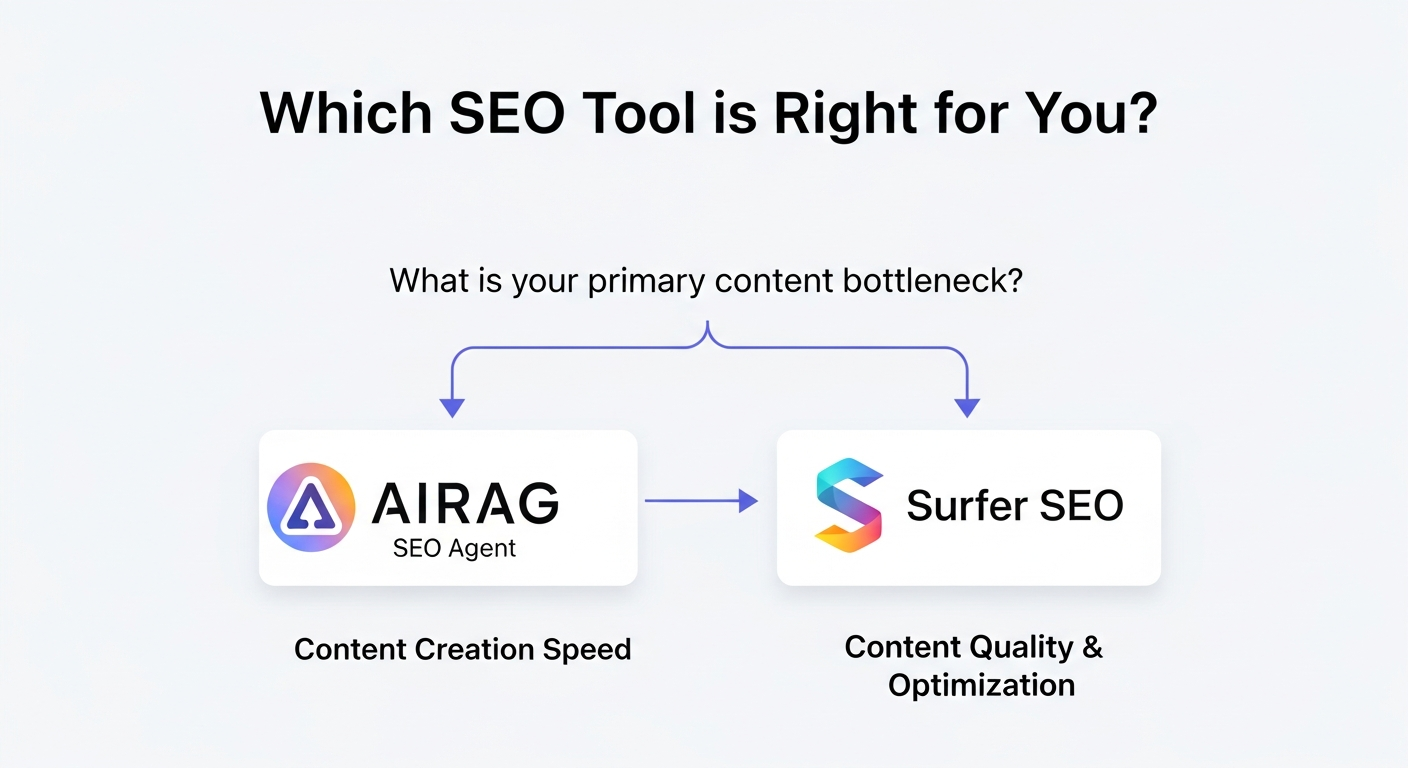
Integration & Workflow: WordPress-Native vs. Platform-Agnostic
AIRAG is built the ‘WordPress Way.’ As a native plugin, everything happens within your secure dashboard, leveraging hooks and WP-Cron for a seamless, efficient workflow. Surfer, as a web-based application, offers flexibility for teams working across different platforms like Google Docs or other CMSs, but requires a less integrated process of writing in one place and publishing in another.
Beyond Content: Support, Community, and Onboarding
Both platforms understand the need for strong user support. Surfer SEO has a well-established community, including active Facebook groups and a wealth of third-party tutorials. AIRAG pSEO Agent, as a product from SHAHISOFT, provides dedicated technical support via email (support@airagpseo.com) and comprehensive documentation, ensuring users can get direct help with the plugin’s integration and features.
Pricing Models in 2026: Investment vs. Expense
The financial commitment for these tools is fundamentally different.
AIRAG pSEO Agent’s Lifetime Access Model
AIRAG pSEO Agent offers a one-time payment for lifetime access. This model positions the tool as a long-term asset and a predictable investment, eliminating recurring subscription fees and providing permanent access to all future updates.
Surfer SEO’s Tiered Subscription Plans
Surfer SEO operates on a standard SaaS subscription model, with tiered plans based on usage. This offers a lower initial cost but represents a recurring monthly or annual operating expense that can increase over time as your needs grow.
The Verdict: Which SEO Tool is Built for the Future of Search?
In the AIRAG pSEO Agent vs Surfer SEO comparison, Surfer SEO is an exceptional tool that has perfected the art of optimizing content for the search algorithms of the last decade. However, the future of search, dominated by AI Overviews and conversational queries, prioritizes citeability, factual accuracy, and brand authority.
This is where AIRAG’s RAG technology provides a decisive advantage. By generating content grounded in your own verified data, it creates assets designed to be cited by AI search systems, establishing your site as a primary source of truth. While Surfer helps you win today’s game by reverse-engineering what already ranks, AIRAG is built to win tomorrow’s by creating original, authoritative content at scale.
If your workflow is centered around a team of human writers who need data-driven guidance, Surfer SEO remains a top-tier choice. But if your goal is to build a scalable, autonomous, and future-proof content powerhouse directly within WordPress, the choice is clear.
Ready to transform your WordPress site into a dynamic, AI-driven authority in your niche? Explore what AIRAG pSEO Agent can do for your business and get lifetime access today.
Frequently Asked Questions
Is AIRAG pSEO Agent a good alternative to Surfer SEO?
Yes, for users whose primary goal is to automate the creation of high-quality, on-brand, and SEO-optimized content directly within WordPress. While Surfer SEO excels at optimizing human-written content, AIRAG is designed to be a complete, autonomous content engine capable of handling the entire process.
What is the main difference between AIRAG and Surfer?
The core difference in the AIRAG pSEO Agent vs Surfer SEO matchup is their function. AIRAG pSEO Agent generates new, complete articles from scratch using your site’s data (RAG) and multiple LLMs. Surfer SEO provides data and guidance to help a human writer optimize an article for a specific keyword.
Can I use AIRAG and Surfer SEO together?
While possible, it would be a redundant workflow. AIRAG is built to handle the entire content lifecycle from generation to SEO optimization and publishing. Using Surfer to then audit content generated by AIRAG would be an unnecessary step, as AIRAG’s process is designed to be comprehensive from the start.
How does AIRAG’s RAG technology make it better for brand accuracy?
Retrieval-Augmented Generation (RAG) allows AIRAG to scan your existing pages, PDFs, and data. It then uses this specific, verified information as a factual foundation for any new content it creates, ensuring every post aligns with your business’s unique knowledge, products, and voice, dramatically reducing hallucinations and improving citeability.