
In the rapidly evolving landscape of digital content, generic AI-generated articles are no longer enough to capture audience attention or rank effectively in search engines. Businesses face the constant challenge of producing high-quality, factually accurate, and brand-aligned content at scale. The solution lies not in more content, but in smarter, context-aware content automation. This is where a new generation of AI tools is making its mark, moving beyond simple text generation to true content intelligence.
AIRAG pSEO Agent emerges as a definitive solution for this new era. It’s an all-in-one AI Content Engine designed specifically for WordPress, leveraging your site’s unique knowledge to drive rankings and authority on autopilot. By grounding its output in your specific business data, it solves the core problems of inaccuracy and brand inconsistency that plague standard AI writers, setting a new benchmark for automated content in 2026.
Table of Contents
- What is AIRAG pSEO Agent?
- The Core Problem with Standard AI Writers (And How RAG Solves It)
- How RAG Directly Impacts Your E-E-A-T and AI Search Citeability
- Unlocking the Power of a Multi-Model AI Engine
- Advanced Strategies: Combining LLMs for a Full-Funnel Content Approach
- Key Features Driving Autonomous SEO Success
- Use Case in Action: How a Real Estate Agency Can Dominate Local SEO
- Common Pitfalls to Avoid with AI Content Automation
- Built the WordPress Way: A Commitment to Security and Performance
- Your First 30 Minutes: A 5-Step Guide to Launching AIRAG pSEO Agent
- Frequently Asked Questions
What is AIRAG pSEO Agent?
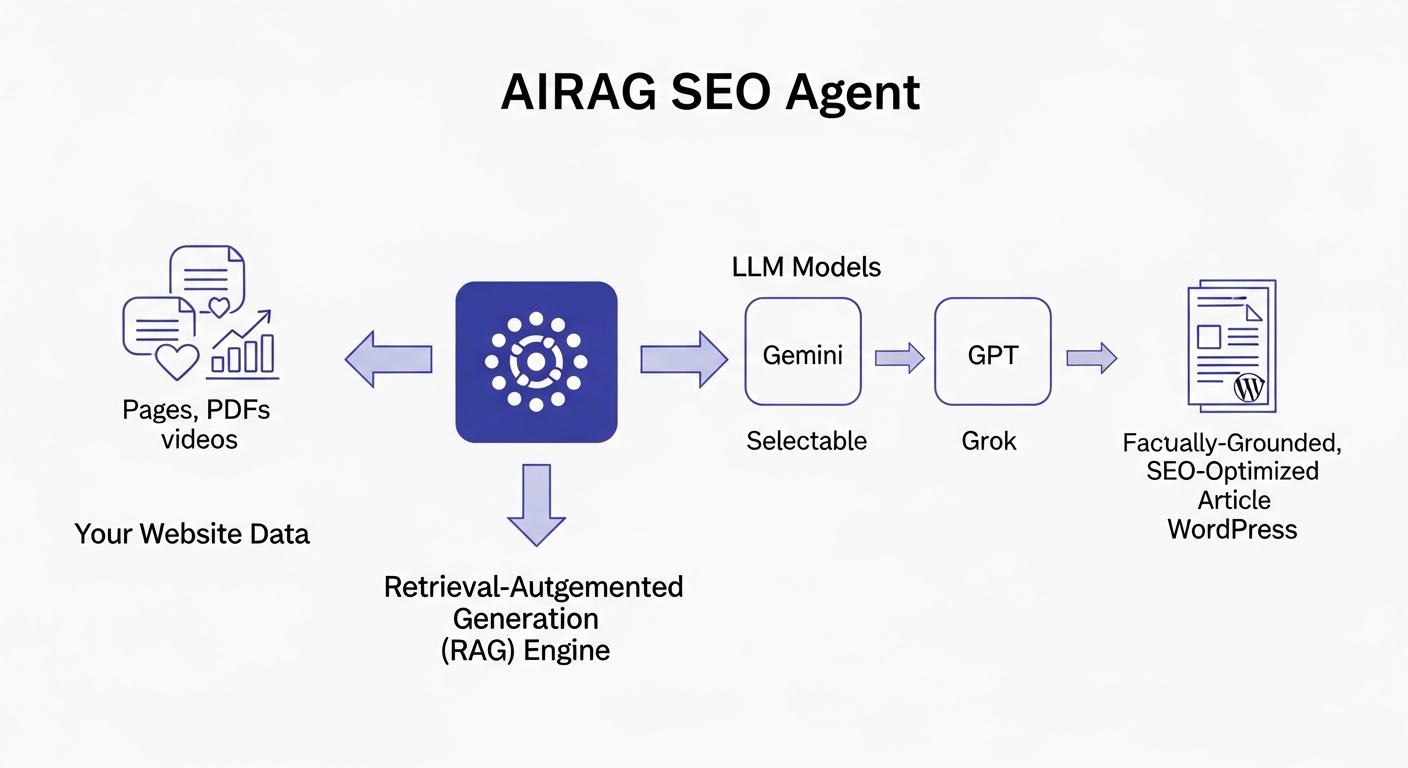
AIRAG pSEO Agent is an all-in-one AI Content Engine for WordPress that combines leading Large Language Models (LLMs) with your site’s unique knowledge base through a technology called Retrieval-Augmented Generation (RAG). This approach ensures every blog post is factually grounded in your specific business data, creating authoritative, high-ranking SEO content automatically.
Unlike other plugins that rely on generic AI prompts, which can lead to factual errors or content that feels disconnected from your brand, AIRAG pSEO Agent operates as an extension of your own expertise. It systematically scans your existing pages, uploaded PDFs, and even image metadata to build a private knowledge base. This repository of your business’s information becomes the single source of truth for the AI, ensuring that every article, from a product deep-dive to a market analysis, is accurate, consistent, and speaks with your unique voice.
The Core Problem with Standard AI Writers (And How RAG Solves It)
Standard AI content tools operate in a vacuum. They pull information from vast, generalized training data, which often results in content that is plausible but not precise. This creates significant risks for businesses, including factual inaccuracies, brand voice inconsistencies, and a lack of true authority. A common mistake businesses make is trusting these generic outputs for niche or technical topics, leading to a loss of credibility with their audience.
Retrieval-Augmented Generation (RAG) directly solves this problem by grounding the AI in your business’s reality. RAG is an advanced AI architecture that combines the generative power of LLMs with a retrieval system. Before writing a single word, the system first retrieves relevant, verified information from your own website content. This retrieved data is then provided to the AI as a strict contextual foundation, compelling it to generate text based on facts you have already established.
This process effectively prevents AI “hallucinations” and ensures every piece of content is a true reflection of your products, services, and brand messaging. The AI isn’t guessing; it’s synthesizing your own knowledge into new, engaging formats.
How RAG Directly Impacts Your E-E-A-T and AI Search Citeability
In the age of AI-driven search, concepts like E-E-A-T (Experience, Expertise, Authoritativeness, Trust) and citeability are paramount. Search engines, including Google’s AI Overviews (formerly Search Generative Experience), are evolving to provide direct answers, and they prioritize sources that are demonstrably authoritative. This is where RAG provides a game-changing advantage.
- Citeability: This refers to how easily an AI search engine can verify a piece of information and cite its source. Content generated by a generic AI is not citable because its origin is a diffuse training model. RAG-generated content, however, is directly derived from your website’s data. When AI search crawlers analyze it, they can trace the facts back to your domain, making your site the authoritative source worthy of citation in an AI Overview.
- Topical Authority: This is the perceived expertise your website has on a specific subject. Publishing a high volume of accurate, consistent, and in-depth content is the key to building it. RAG accelerates this process by allowing you to create comprehensive content clusters based on your core business knowledge, reinforcing your authority with every post.
- Demonstrating E-E-A-T: RAG inherently boosts E-E-A-T signals. The content demonstrates Experience and Expertise because it’s based on your proprietary data and real-world knowledge. It builds Authoritativeness by establishing your site as the primary source. Finally, it fosters Trust by ensuring every claim is factually accurate and consistent with your brand messaging.
By using your own website as the source of truth, RAG generates content that is structurally designed to perform well in modern, AI-powered search ecosystems.
Unlocking the Power of a Multi-Model AI Engine
AIRAG pSEO Agent further distinguishes itself by providing a multi-model AI engine, giving you the strategic flexibility to choose the right AI for the right task—all from a single WordPress dashboard. This is a crucial advantage, as different LLMs excel in different areas.
- Gemini for Massive Context: When you need to create comprehensive articles that require a deep understanding of complex topics, Gemini’s large context window is ideal. It can process and synthesize vast amounts of information from your knowledge base to produce in-depth, nuanced content.
- GPT for Creative Flair: For top-of-funnel blog posts, social media content, or marketing copy that needs to be highly engaging, OpenAI’s GPT models offer unparalleled creative flair and stylistic versatility.
- Grok for Real-Time Logic: When your content needs to incorporate real-time information or requires complex logical reasoning, Grok provides the ability to generate outputs that are timely and analytically sharp.
A key strategy to consider is model-stacking for content creation. For a technical whitepaper, you might start with Gemini to process and summarize your source PDFs due to its large context window. Then, you could use that detailed draft as a basis for GPT to create a more accessible summary blog post, ensuring both technical depth and broad readability.
Advanced Strategies: Combining LLMs for a Full-Funnel Content Approach
Using a multi-model AI engine isn’t just about choice; it’s about strategy. You can align specific LLMs with different stages of the marketing funnel to create a cohesive content journey for your audience.
- Top-of-Funnel (ToFu) with GPT: At this stage, the goal is awareness and engagement. Use GPT’s creative strengths to generate captivating blog posts, listicles, and social media prompts that address broad industry questions and attract a wide audience.
- Middle-of-Funnel (MoFu) with Gemini: Here, potential customers are evaluating solutions. Leverage Gemini’s ability to handle large contexts to create detailed comparison articles, in-depth feature explanations, and case studies by feeding it multiple product pages or competitor analysis documents from your knowledge base.
- Bottom-of-Funnel (BoFu) with Grok: At the decision stage, users need timely, data-driven information. Use Grok to generate content based on real-time market trends, answer highly specific questions with logical precision, or create ROI calculation guides that help seal the deal.
Key Features Driving Autonomous SEO Success
Beyond its core RAG and multi-model architecture, AIRAG pSEO Agent includes a suite of features designed to turn your WordPress site into a dynamic, AI-driven powerhouse.
Video-to-Blog Intelligence
Transform any YouTube URL into a long-form, SEO-optimized article. The AI analyzes video transcripts and visual metadata to create a high-ranking blog post, allowing you to repurpose content and capture valuable search traffic.
Strategic Content Repurposing: A Framework for Choosing the Right Videos
To maximize impact, choose videos strategically. Prioritize webinars, product demos, expert interviews, or conference talks. These formats are rich with unique insights and structured information that the AI can effectively transform into authoritative written content. A 20-minute product walkthrough video can become a 2,500-word ultimate guide, complete with step-by-step instructions and feature breakdowns.
Autonomous Schedule Manager
Define your content strategy once and let automation handle the rest. Integrated with WP-Cron, this feature allows you to plan and schedule the generation and publishing of posts daily, weekly, or monthly.
Building a Hands-Off Content Calendar: From Topic Clusters to Publishing Cadence
Use the scheduler to build topical authority systematically. For example, plan a month-long content cluster around a core service. Schedule one pillar post (a comprehensive guide) for week one, followed by three weekly sub-topic posts that delve into specific aspects. The AI, guided by your RAG knowledge base, will ensure all posts are interlinked conceptually, creating a powerful SEO cluster that signals your expertise to search engines.
Use Case in Action: How a Real Estate Agency Can Dominate Local SEO
To understand the practical power of AIRAG, consider a local real estate agency. Their goal is to become the go-to resource for their city.
- Build the Knowledge Base: They start by uploading crucial documents to the RAG engine: local market analysis reports (PDFs), neighborhood zoning laws, and internal guides on the home-buying process. The plugin automatically scans their existing website pages about specific listings and agent bios.
- Repurpose Video Content: They take the YouTube URLs from their 20+ video property tours and use the Video-to-Blog feature. Within hours, they have detailed blog posts for each property, complete with descriptive text about features mentioned in the video.
- Automate Hyper-Local Content: Using the Autonomous Scheduler, they set up a weekly content plan. They create post templates like “[Neighborhood Name]: A Complete Guide” and “Monthly Market Trends in [City Name]”. The RAG engine pulls data from the uploaded reports to generate unique, data-rich articles for each neighborhood, establishing the agency as a local data authority.
The result is a website that consistently publishes expert, hyper-local content, building immense topical authority and dominating local search rankings with minimal ongoing effort.
Common Pitfalls to Avoid with AI Content Automation
While AI offers incredible potential, a naive implementation can lead to poor results. Experienced developers and marketers are wary of several common issues, which AIRAG is designed to solve.
- Pitfall 1: Generic, Soulless Content. Standard AI often produces text that lacks a unique perspective. Solution: RAG ensures content is infused with your brand’s specific data, terminology, and viewpoint.
- Pitfall 2: Factual Inaccuracies. AI models can “hallucinate” facts, damaging credibility. Solution: RAG grounds every statement in your verified knowledge base, acting as a factual guardrail.
- Pitfall 3: Lack of Strategic Direction. Simply producing random articles is ineffective. Solution: The Autonomous Scheduler enables a topic cluster strategy, allowing you to build authority methodically.
- Pitfall 4: One-Size-Fits-All Tone. A single AI voice doesn’t work for all content types. Solution: The multi-model engine allows you to match the AI’s strength (creative, analytical, real-time) to the content’s purpose.
Built the WordPress Way: A Commitment to Security and Performance
A powerful plugin is only as good as its integration and security. AIRAG pSEO Agent is built from the ground up following WordPress coding standards and best practices, ensuring seamless, secure, and efficient operation.
- WP Standards & APIs: The plugin fully utilizes WordPress hooks, filters, the REST API, and AJAX. This ensures maximum compatibility with other plugins and themes.
- Security First: The plugin is built with best practices at its core, including input sanitization, nonces to verify user actions, and capability checks to ensure proper permissions.
- Optimized & Dynamic: To minimize server load, content generation is handled efficiently using AJAX and WP-Cron, making the plugin lightweight and performant.
Generic AI Writer vs. AIRAG pSEO Agent with RAG
| Feature | Generic AI Writer | AIRAG pSEO Agent |
|---|---|---|
| Data Source | General internet training data | Your specific website content (pages, PDFs, images) |
| Factual Accuracy | Prone to “hallucinations” and inaccuracies | High; factually grounded in your verified data |
| Brand Consistency | Inconsistent; requires heavy editing for tone | Consistently on-brand and in your voice |
| AI Model Flexibility | Locked into a single AI model | Switch between Gemini, GPT, and Grok |
| Content Citeability | Low; outputs are not based on a verifiable source | High; content is designed to be cited in AI search overviews |
Your First 30 Minutes: A 5-Step Guide to Launching AIRAG pSEO Agent
Transitioning from manual content creation to an automated, intelligent workflow is simple. This guide will walk you through deploying AIRAG pSEO Agent and generating your first authoritative article in under 30 minutes.
- Step 1: Installation & Activation: After purchasing, download the plugin .zip file. From your WordPress dashboard, navigate to ‘Plugins’ > ‘Add New’ > ‘Upload Plugin’. Select the file and click ‘Install Now’, then ‘Activate’.
- Step 2: Building Your Knowledge Base: Go to the AIRAG pSEO Agent settings. The plugin will begin scanning your existing published pages and posts. You can also navigate to the ‘Knowledge Base’ tab and upload your first key documents, such as a company overview PDF or a product specification sheet.
- Step 3: Connecting Your LLM API Keys: In the ‘Settings’ or ‘Integrations’ tab, you will find fields to enter your API keys for OpenAI (GPT), Google (Gemini), and/or Grok. Securely add your keys to enable the AI models.
- Step 4: Configuring Your First Automated Post: Navigate to the ‘Scheduler’ or ‘Content Generation’ tab. Create a new task. Enter a topic or title, select your desired LLM, set the tone and audience level, and schedule it to run immediately or at a future date.
- Step 5: Reviewing & Publishing: Once the article is generated, it will appear in your ‘Posts’ as a draft. Always perform a final human review to ensure it meets your strategic goals and add any final touches before hitting ‘Publish’.
Frequently Asked Questions
What makes AIRAG pSEO Agent different from other AI content plugins for WordPress?
The primary difference is its use of Retrieval-Augmented Generation (RAG), which grounds all content in your specific website data (pages, PDFs, etc.) to ensure factual accuracy and brand consistency. AIRAG pSEO Agent also offers a multi-model AI engine, allowing you to choose between Gemini, GPT, and Grok for different tasks, rather than being locked into a single provider.
Do I need technical skills to use the Autonomous Schedule Manager?
No, the scheduler is designed to be user-friendly. You can define your content strategy (topics, frequency) once through the WordPress dashboard, and the WP-Cron integrated system handles the generation and publishing automatically—daily, weekly, or monthly.
How does the Video-to-Blog feature analyze a YouTube video?
The AI analyzes the video’s transcript, spoken content, on-screen text, and visual metadata. It then synthesizes this information to create a comprehensive, long-form, and SEO-optimized blog post that captures the core message and details of the video.
Is AIRAG pSEO Agent secure to use on my production website?
Yes. It is built following WordPress security best practices, including input sanitization, the use of nonces for verification, and proper capability checks to ensure users only have access to appropriate functions. This focus on security is designed to keep your site safe.
Businesses leveraging this technology are not just automating content; they are scaling their expertise. By ensuring every article is factually grounded and optimized for search, you can save countless hours, significantly boost your SEO performance, and establish a dominant presence in your industry. Ready to put your content on autopilot? Purchase today for a one-time payment and gain lifetime access to the future of content automation.