
In the rapidly evolving landscape of digital marketing, content remains king. However, as of 2026, the throne is being challenged by the proliferation of generic, uninspired AI-generated text that fails to rank, engage, or convert. Many businesses using standard AI tools find themselves producing content that lacks factual accuracy, brand voice, and the unique insights that build topical authority. This is where a new generation of AI, grounded in your reality, becomes essential. The AIRAG pSEO Agent represents this paradigm shift, offering a sophisticated AI content engine directly within your WordPress dashboard.
This all-in-one solution moves beyond basic text generation by integrating flagship Large Language Models (LLMs) with your site’s unique knowledge base. By leveraging a powerful technology called Retrieval-Augmented Generation (RAG), AIRAG ensures every article, blog post, and page is not just created, but crafted with precision, accuracy, and your specific business data. It’s a system designed to get your content cited in search, drive rankings on autopilot, and transform your WordPress site into a true content powerhouse.
Table of Contents
- What Is AIRAG pSEO Agent?
- The RAG Advantage: Grounding AI in Your Business Reality
- RAG vs. Fine-Tuning: Why RAG is the Superior Choice for Brand-Specific Content
- Harnessing Multi-Model AI: A Strategic Guide to Choosing the Right Engine
- Core Features: Your Complete Content Automation Toolkit
- Practical Workflows: How to Integrate AIRAG into Your Content Strategy
- Common Pitfalls in AI Content Automation (And How AIRAG Solves Them)
- The Future of SEO: Why ‘Citeability’ in AI Overviews is Your Most Important Metric
- The Business Impact: How AIRAG Drives Rankings and Saves Hours
- Built the WordPress Way: Seamless, Secure, and Optimized
- Getting Started with AIRAG pSEO Agent
- Frequently Asked Questions (FAQ)
What Is AIRAG pSEO Agent?
AIRAG pSEO Agent is an advanced AI content engine for WordPress that automates the creation of high-ranking, factually grounded SEO blogs and articles. Unlike other plugins that rely on generic AI models, AIRAG integrates Retrieval-Augmented Generation (RAG) to use your own website’s data—including pages, PDFs, and even images—as the source of truth for all content generation. This ensures every piece of content is unique, authoritative, and perfectly aligned with your brand.
An All-in-One AI Content Engine for WordPress
At its core, AIRAG pSEO Agent functions as a centralized command center for your entire content strategy. It combines the power of multiple flagship LLMs, such as OpenAI’s GPT models, Google’s Gemini, and Grok, within a single, secure WordPress dashboard. This multi-model approach allows you to select the best AI for any given task, whether you need creative flair, deep contextual analysis, or real-time logical reasoning. The platform is designed to handle everything from ideation to final publication, effectively putting your content creation on autopilot.
The Core Mission: Creating Content That Gets Cited
In the age of AI-powered search and generative overviews, ‘citeability’ has become a crucial SEO metric. Search engines and AI systems prioritize content that is factual, verifiable, and authoritative. The core mission of AIRAG pSEO Agent is to generate exactly this type of content. Because every article is grounded in your specific business data via RAG, the information is inherently more accurate and trustworthy than generic AI output. This makes your content a prime candidate for being cited in AI-driven search results, establishing your website as a definitive source of information in your niche.
The RAG Advantage: Grounding AI in Your Business Reality
Retrieval-Augmented Generation (RAG) is a sophisticated AI technique that enhances the output of Large Language Models by grounding them in a specific, verified knowledge base. Instead of generating text based solely on its vast but generic training data, a RAG-powered system first retrieves relevant information from your own documents, pages, and files. This retrieved data is then used as a direct reference to generate a response, ensuring the final content is factually accurate and contextually relevant to your business.
How AIRAG Scans Your Pages, PDFs, and Data to Ensure Factual Accuracy
The AIRAG pSEO Agent implements RAG by first creating a comprehensive knowledge base from your website. It systematically scans your existing pages, uploaded PDFs, product descriptions, and even image metadata. This information is indexed and stored securely, becoming the exclusive source of truth for the AI. When you prompt the system to create a new blog post, it doesn’t just ask the LLM a generic question. Instead, it finds the most relevant passages from your indexed data and provides them to the AI as a strict guideline, instructing it to build the article based on these verified facts. This process virtually eliminates the risk of AI ‘hallucinations’ and ensures the content reflects your actual products, services, and expertise.
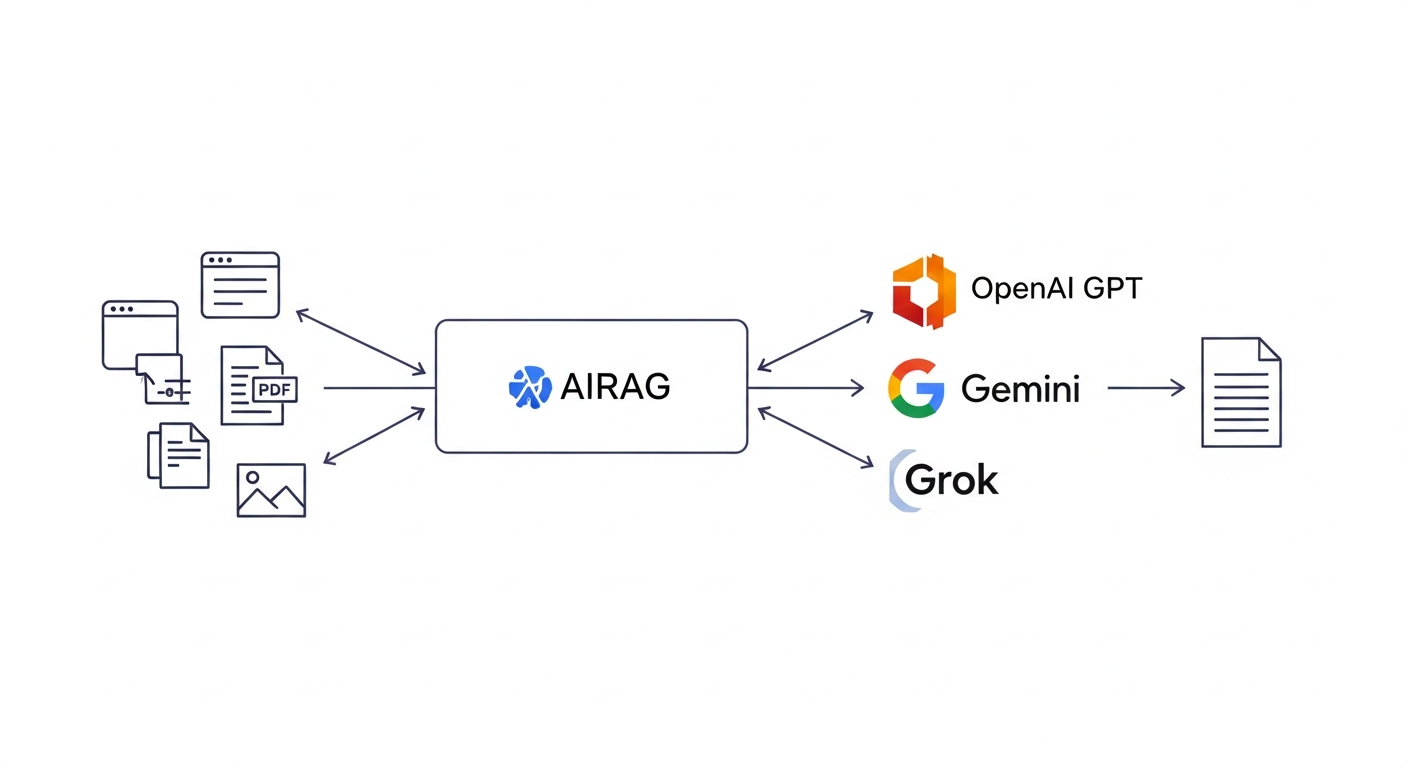
Why RAG is a Game-Changer for Brand-Aligned, Authoritative Content
The strategic importance of RAG cannot be overstated. It is the key differentiator between creating generic content and producing strategic brand assets. By using your own data, RAG ensures perfect brand alignment; the AI learns your terminology, understands your value propositions, and adopts your unique voice. This leads to authoritative content that builds trust with your audience and establishes your credibility with search engines. In an internet flooded with repetitive AI articles, RAG-powered content stands out as authentic, reliable, and uniquely valuable—the very qualities that drive long-term SEO success.
RAG vs. Fine-Tuning: Why RAG is the Superior Choice for Brand-Specific Content
When aiming to make an AI model speak with your brand’s voice and knowledge, two primary methods emerge: RAG and fine-tuning. While both have their place, RAG offers distinct advantages for creating fact-based, dynamic content within a WordPress environment.
Fine-tuning involves retraining a base LLM on a large, curated dataset of your own examples. This process alters the model’s internal weights to teach it a specific style, tone, or knowledge set. However, it is computationally expensive, time-consuming, and static. Once a model is fine-tuned, its knowledge is frozen in time; it cannot incorporate new information without being retrained all over again. Furthermore, it’s difficult to trace where a specific piece of information came from, making fact-checking a challenge.
Retrieval-Augmented Generation (RAG), the method used by AIRAG pSEO Agent, takes a more flexible and transparent approach. Instead of altering the core model, it provides the model with up-to-date, relevant information ‘just-in-time’ from your knowledge base for each query. This makes it ideal for businesses whose products, services, or best practices evolve. You can simply update a PDF or a webpage, and AIRAG will immediately start using that new information in its content generation. This approach is more cost-effective, easily updatable, and provides clear source attribution, which is critical for creating trustworthy, citable content.
Harnessing Multi-Model AI: A Strategic Guide to Choosing the Right Engine
The AIRAG pSEO Agent provides unparalleled flexibility by integrating multiple leading AI models into one platform. This multi-model architecture acknowledges that there is no one-size-fits-all solution for content creation. Different tasks require different AI strengths. Here’s how to strategically choose the right tool for the job to maximize your content’s impact.
When to Choose a Creative AI: Crafting Brand Stories with GPT
OpenAI’s GPT models are renowned for their creative prowess and nuanced understanding of human language. They excel at tasks that require style, persuasion, and a strong narrative.
- Strengths for SEO: Excellent for top-of-funnel content, engaging introductions, compelling conclusions, and marketing copy. GPT can adopt specific tones (e.g., witty, empathetic, professional) with remarkable accuracy, making it perfect for brand storytelling.
- Weaknesses: Without RAG, it can be more prone to creative ‘hallucinations’ on factual topics. Its knowledge is limited to its last training date, making it unsuitable for real-time news or trends.
- Practical Use Cases:
1. Landing Page Copy: Crafting persuasive copy that highlights benefits over features.
2. Brand Origin Stories: Writing the ‘About Us’ page or a blog post detailing the company’s journey.
3. Email Newsletters: Generating engaging, personalized email content to nurture leads. - Example Prompt: “Using the provided context about our company’s founding, write a 300-word section for our ‘About Us’ page. Adopt a passionate and inspiring tone, focusing on our mission to solve [customer problem].”
When to Choose an Analytical AI: Building Pillar Content with Gemini
Google’s Gemini models are built for handling massive amounts of information and complex reasoning. Their large context windows make them ideal for synthesizing data and creating comprehensive, deeply researched content.
- Strengths for SEO: Unmatched for creating long-form pillar posts, ultimate guides, and in-depth tutorials. Gemini can analyze and consolidate information from multiple documents in your RAG knowledge base to produce a single, authoritative article.
- Weaknesses: The creative output can sometimes be more straightforward or less stylized than GPT’s unless specifically prompted.
- Practical Use Cases:
1. Ultimate Guides: Synthesizing five or six related blog posts from your site into a single, 4000-word pillar page.
2. Technical Whitepapers: Analyzing technical documentation from your PDFs to generate a detailed whitepaper for a B2B audience.
3. Comparative Analysis: Creating a detailed comparison article (e.g., ‘Product A vs. Product B’) by pulling specifications from multiple product pages.
When to Choose a Real-Time AI: Capitalizing on Trends with Grok
Grok stands out with its ability to access and process real-time information from the web. This makes it the go-to choice for content that needs to be timely, relevant, and connected to current events.
- Strengths for SEO: Perfect for news-jacking, writing about industry trends, and creating content that answers questions about recent developments. It adds a layer of timeliness that builds credibility and can capture trending search traffic.
- Weaknesses: As a newer model, its creative range might be less refined than more established models for certain stylistic tasks.
- Practical Use Cases:
1. Weekly Industry News Roundups: Generating a summary of the week’s most important news and its impact on your customers.
2. Event-Based Content: Writing a post about a recent industry conference or a major algorithm update.
3. Market Commentary: Creating analysis on how current economic or political events affect your niche.
Core Features: Your Complete Content Automation Toolkit
The AIRAG pSEO Agent is more than just a text generator; it’s a comprehensive suite of tools designed to automate and elevate every aspect of your WordPress content strategy.
Video-to-Blog Intelligence: Turn Any YouTube URL into a High-Ranking Article
This powerful tool allows you to transform any YouTube URL into a fully-formed, long-form, and SEO-optimized article. The AI analyzes the transcript and visual metadata to create a well-structured blog post. Below is a practical workflow for leveraging this feature.
How to Turn a 1-Hour Webinar into a High-Ranking Pillar Post in 5 Steps
- Step 1: Select Your Source Video. Choose a high-value video asset like a customer webinar, a product demo, or an expert interview. Ensure the audio is clear and the content is rich with information.
- Step 2: Input the URL into AIRAG. Navigate to the AIRAG pSEO Agent dashboard in WordPress and paste the YouTube URL into the Video-to-Blog feature.
- Step 3: Define Your SEO Parameters. Provide a target keyword for the article, specify the desired tone (e.g., ‘Educational and Authoritative’), and select the most appropriate AI model (Gemini is often best for synthesizing long-form content).
- Step 4: Generate the First Draft. The AI will process the entire video and generate a structured article, complete with headings, paragraphs, and lists. This process typically takes just a few minutes.
- Step 5: Review, Refine, and Publish. The generated content will be a high-quality draft. Take 15-20 minutes to add your own human touch: insert internal links, add a custom introduction, and include a call-to-action. Then, hit publish. You’ve just repurposed an hour of video into a permanent SEO asset.
Autonomous Schedule Manager: Set-and-Forget Publishing with WP-Cron Integration
Consistency is key to SEO success. By integrating directly with WP-Cron, this feature lets you put your content calendar on autopilot. Define your content strategy—including topics, keywords, and post frequency—and the AIRAG pSEO Agent will handle the generation and publishing automatically.
Global Brand Voice: Master Tone and Language Across 40+ Locales
For businesses with a global reach, the Global Brand Voice feature provides granular control over the output, supporting over 40 languages. You can precisely define the desired Audience Level (from beginner to expert) and Tone (from casual to formal), ensuring every piece of content perfectly reflects your brand’s identity.
Practical Workflows: How to Integrate AIRAG into Your Content Strategy
The true power of AIRAG pSEO Agent is unlocked when it’s integrated into a repeatable workflow. Here’s how different types of businesses can leverage the platform to solve specific challenges and scale their content production.
Workflow for E-commerce: Automating SEO-Friendly Product Descriptions
The Challenge: Manually writing unique, compelling, and SEO-optimized descriptions for hundreds or thousands of products is a monumental task.
The AIRAG Workflow:
1. Create a detailed PDF or Google Doc for each product category that outlines key features, materials, target customer, and use cases. Upload these to the WordPress media library.
2. Use the AIRAG scheduler to create a new task. Instruct it to generate descriptions for a specific product SKU or category.
3. In the prompt, reference the uploaded documentation: “Using the ‘Handbag-Spec-Sheet.pdf’ as a source, write a 150-word product description for the ‘Artisan Leather Tote’. Use a ‘Luxury and Elegant’ tone and include the keywords ‘full-grain leather’ and ‘handcrafted’.”
4. Schedule the agent to run this task for all new product SKUs, automating the entire process and ensuring brand consistency.
Workflow for Marketing Agencies: Scaling Client Content Production
The Challenge: Producing high-quality, brand-aligned content for a diverse portfolio of clients on a tight schedule and budget.
The AIRAG Workflow:
1. For each new client, spend the first hour creating a ‘Brand Knowledge Base’ by uploading their key marketing materials, case studies, and service pages as PDFs.
2. Create a unique content schedule for each client within the Autonomous Schedule Manager.
3. Use the Global Brand Voice feature to lock in each client’s specific tone (e.g., Client A: Formal B2B, Client B: Casual B2C).
4. Leverage the Video-to-Blog feature to repurpose client webinars and interviews, dramatically increasing content output without increasing billable hours. This allows the agency to scale its services profitably.
Workflow for Niche Bloggers: Building Topical Authority on Autopilot
The Challenge: A solo blogger needs to publish consistently to build topical authority but is limited by time and resources.
The AIRAG Workflow:
1. Write and upload 3-5 foundational ‘cornerstone’ articles that detail your core expertise.
2. Set up a weekly schedule in AIRAG. For the prompt, instruct the AI to generate a new article on a long-tail keyword that supports one of your cornerstone pieces. For example: “Using my article ‘Ultimate Guide to Sourdough Baking’ as the primary source, write a 1200-word blog post on ‘How to maintain a sourdough starter in cold climates’.”
3. This creates a highly-interlinked content cluster over time, with the AI systematically building out your topic authority based on your own expert knowledge.
Common Pitfalls in AI Content Automation (And How AIRAG Solves Them)
While generative AI offers incredible potential, a naive implementation can lead to significant problems that harm your brand and SEO. Here are common pitfalls and how AIRAG’s architecture is designed to prevent them.
- The Pitfall of Factual Inaccuracy: Standard AI models can ‘hallucinate’ or invent facts, statistics, and product details. Publishing inaccurate information erodes trust and can lead to negative SEO impacts.
The AIRAG Solution: The RAG system is the antidote. By forcing the AI to base its output on your own verified documents, it drastically reduces the risk of factual errors. The content is grounded in your reality, not the AI’s generic knowledge. - The Pitfall of Brand Voice Inconsistency: Using generic AI often results in content that sounds robotic or doesn’t match your established brand personality. This inconsistency can confuse your audience and dilute your brand identity.
The AIRAG Solution: The Global Brand Voice feature provides precise control over tone and audience level. By combining this with the RAG system, which learns your specific terminology, the AI consistently produces content that sounds like it came directly from your team. - The Pitfall of Generic, ‘Me-Too’ Output: If you and your competitors are all using the same AI with similar prompts, you will all produce similar-sounding content. This fails to differentiate your brand and provides little value to the reader.
The AIRAG Solution: Because AIRAG uses your unique business data as its foundation, your content is inherently original. It contains insights, details, and perspectives that your competitors’ generic AI simply cannot access, giving you a sustainable competitive advantage.
The Future of SEO: Why ‘Citeability’ in AI Overviews is Your Most Important Metric
As of 2026, the search landscape has fundamentally shifted. Google’s AI Overviews and other generative AI search systems now frequently answer user queries directly on the results page. In this new paradigm, simply ranking #1 is not enough. The ultimate goal is to become a cited source within these AI-generated answers. This is what we call ‘citeability’.
Citeability is the measure of how likely your content is to be trusted and referenced by an AI search engine as the factual basis for its answer. AI models are trained to prioritize information from sources that demonstrate expertise, authoritativeness, and trustworthiness (E-E-A-T). They look for content that is factually dense, well-structured, and internally consistent. Generic, vague, or unverified content is actively ignored.
This is where AIRAG pSEO Agent’s core architecture provides a decisive advantage. By using RAG to create fact-based AI content grounded in your own specific data, you are producing precisely the kind of material that AI search engines are designed to trust. When your website consistently publishes articles with verifiable details about your products, services, and industry, you are building a repository of citable facts. This positions your site not just as a destination for users, but as an authoritative data source for the AI itself, ensuring your brand’s visibility and authority in the future of search.
The Business Impact: How AIRAG Drives Rankings and Saves Hours
Implementing the AIRAG pSEO Agent is a strategic business decision with a clear return on investment. By automating content creation, the plugin directly impacts your bottom line by boosting efficiency and improving SEO performance.
A Hypothetical Case Study in Action
Consider a B2B SaaS company struggling to produce consistent help documentation. Their support team is overwhelmed, and their online knowledge base is sparse. Using AIRAG, they upload their internal technical manuals as PDFs. They then set up an autonomous schedule to publish one new, in-depth tutorial every week, targeting common customer questions. The RAG feature ensures every tutorial is 100% accurate according to their official documentation. Within three months, they see a 20% reduction in support tickets and their new tutorials start ranking for high-intent search queries, driving qualified leads.
| Feature | Standard AI Plugins | AIRAG pSEO Agent |
|---|---|---|
| Data Source | Generic, public AI training data | Your website’s unique data (RAG) |
| AI Model Access | Single, fixed AI model | Multi-Model: GPT, Gemini, & Grok |
| Content Sourcing | Text prompts only | Text prompts & Video-to-Blog |
| Automation | Manual content generation | Autonomous WP-Cron Scheduler |
| Factual Grounding | Low (Prone to hallucinations) | High (Grounded in your data) |
Built the WordPress Way: Seamless, Secure, and Optimized
For any tool to be truly effective within the WordPress ecosystem, it must be built with a deep respect for its standards and security. The AIRAG pSEO Agent was developed from the ground up to be a model WordPress citizen. You can learn more about the philosophy behind AIRAG pSEO Agent and its commitment to quality on our about page.
Full Compliance with WordPress Coding Standards, Hooks, and APIs
The plugin fully adheres to the official WordPress coding standards. This commitment ensures maximum compatibility with other themes and plugins, minimizing the risk of conflicts. It leverages the native WordPress ecosystem by using hooks, filters, the REST API, and AJAX for its operations.
A Security-First Architecture: Input Sanitization, Nonces, and Capability Checks
The AIRAG pSEO Agent is built with a security-first mindset. All user inputs are rigorously sanitized to prevent malicious code injection. It uses WordPress nonces to protect against Cross-Site Request Forgery (CSRF) attacks and implements proper capability checks to ensure that only authorized users can access its features.
Lightweight and Dynamic Performance Using AJAX and Efficient Cron Jobs
The AIRAG pSEO Agent is engineered to be efficient and lightweight. It uses AJAX for dynamic content loading and WP-Cron for background processing to minimize server load, ensuring your site remains fast and responsive.
Getting Started with AIRAG pSEO Agent
Transforming your WordPress content strategy with AIRAG pSEO Agent is a straightforward process. The platform is designed for easy adoption, allowing you to go from installation to automated content generation quickly.
Simple Installation and Configuration Process
Getting started is as simple as installing any standard WordPress plugin. Once installed and activated, a user-friendly setup wizard guides you through the initial configuration. You will connect your AI model APIs and instruct the agent to begin scanning your site to build its initial knowledge base.
Understanding the One-Time Payment for Lifetime Access
One of the most compelling aspects of AIRAG pSEO Agent is its pricing model. Instead of a recurring monthly subscription, the plugin is available for a one-time payment. This purchase grants you lifetime access to the plugin and all its features, as well as future updates, providing exceptional long-term value.
How to Define Your First Content Strategy and Schedule
Once configured, your first step is to visit the Autonomous Schedule Manager. Here, you will define your content strategy. You can create content plans based on specific keywords or topics. Set the desired model, define the tone and language, and choose your publishing frequency. Once you save this strategy, your automated content powerhouse is officially online.
Frequently Asked Questions (FAQ)
What makes AIRAG pSEO Agent different from other AI writers?
The key differentiator is its use of Retrieval-Augmented Generation (RAG). While other plugins generate generic content, AIRAG first scans your own website’s pages, PDFs, and data to ensure every article is factually grounded in your specific business knowledge, products, and services. The AIRAG pSEO Agent also offers the flexibility to switch between multiple flagship LLMs like GPT, Gemini, and Grok.
Is AIRAG pSEO Agent safe for my WordPress website?
Yes. It is built with WordPress security best practices at its core, including input sanitization, the use of nonces, and proper capability checks. It fully adheres to WordPress coding standards to ensure safe and seamless integration with your existing themes and plugins.
Can I really convert a YouTube video into a blog post?
Absolutely. The Video-to-Blog Intelligence feature allows you to input any YouTube URL. The AI analyzes the video’s transcript and visual metadata to create a comprehensive, long-form, and SEO-optimized article based on its content, making content repurposing incredibly efficient.
Does this plugin support languages other than English?
Yes, AIRAG pSEO Agent offers Global Brand Voice support for over 40 languages. You can also define the precise audience level and tone (from casual to formal) to ensure all generated content matches your brand’s global identity and communicates effectively with diverse audiences.
How does the content scheduler work?
The Autonomous Schedule Manager integrates directly with WP-Cron, WordPress’s built-in scheduling system. You can define your content strategy once—setting topics, frequency, and other parameters—and the plugin will handle the generation and publishing of posts automatically on a daily, weekly, or monthly basis.
By embracing the power of RAG, multi-model AI, and intelligent automation, the AIRAG pSEO Agent provides a definitive solution for businesses ready to elevate their content strategy. It’s an investment in creating a scalable, authoritative, and truly unique digital presence that drives measurable results.
Ready to transform your WordPress content strategy and dominate your niche? Businesses are leveraging AIRAG pSEO Agent to save hours, boost SEO, and create content that gets cited. Purchase today for a one-time payment and get lifetime access to the future of content automation.