
In the rapidly evolving landscape of digital content, generic AI-generated articles are no longer enough to capture audience attention or rank in competitive search results. To succeed in 2026 and beyond, businesses must build deep topical authority and maintain consistent content velocity—two pillars of modern SEO that generic tools fail to support. Businesses need content that is not only optimized but is also factually accurate, reflects their unique brand voice, and is grounded in their specific expertise. This is where the AIRAG pSEO Agent emerges as a transformative solution, offering an all-in-one AI content engine designed specifically for WordPress to drive rankings and authority on autopilot.
This advanced WordPress plugin moves beyond simple text generation by integrating cutting-edge Retrieval-Augmented Generation (RAG) technology with a suite of flagship Large Language Models (LLMs). By leveraging your site’s own knowledge base, AIRAG pSEO Agent ensures every piece of content is a true reflection of your business, built for the new era of AI-powered search where accuracy and citeability are paramount. Whether you aim to automate your blog, transform videos into articles, or scale your content globally, this tool provides the intelligence and power you need.
Table of Contents
- What is AIRAG pSEO Agent?
- The Core Technology: How RAG Elevates Your Content
- Harnessing Multi-Model AI: The Strategic Power of Choice
- Key Features to Automate and Dominate Your Niche
- A Strategic Guide to Implementing AIRAG for Maximum SEO Impact
- Built the WordPress Way: Security, Performance, and Integration
- Why AIRAG is Built for the Future of AI Search
- Frequently Asked Questions (FAQ)
What is AIRAG pSEO Agent?
AIRAG pSEO Agent is an advanced AI content engine for WordPress that automates the creation of high-ranking, factually accurate blog posts. It distinguishes itself from other AI tools by using Retrieval-Augmented Generation (RAG) to ground all content in your website’s specific data, ensuring brand alignment and authority. It is designed to be a comprehensive, set-and-forget solution for businesses looking to scale their content strategy efficiently.
An AI Content Engine Built for Rankings
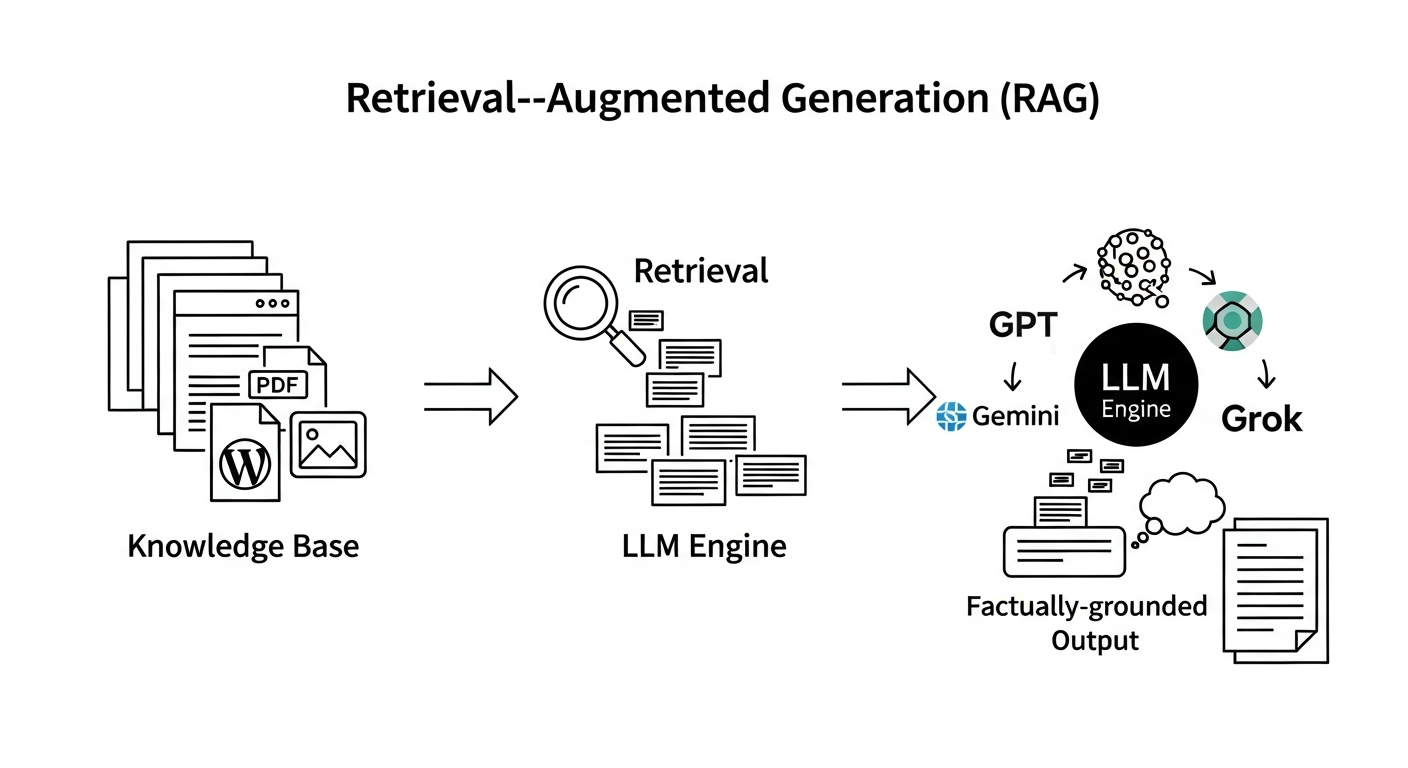
At its core, AIRAG pSEO Agent is not just a writer but a strategic SEO tool. It combines the power of leading LLMs like OpenAI’s GPT, Google’s Gemini, and xAI’s Grok within a single WordPress dashboard. This multi-model approach allows users to select the best AI for any given task, from creative brainstorming to deep, data-driven analysis. The entire system is built to produce content that gets cited in modern search engine results, including AI Overviews, by prioritizing factual accuracy and relevance derived directly from your business.
From AIBG INTELLIAGENT to a Leading SEO Tool
As a product from SHAHISOFT, AIRAG pSEO Agent has a history of innovation. Formerly known as AIBG INTELLIAGENT, the platform has evolved into a sophisticated, SEO-verified product trusted by businesses to save countless hours and dominate their niches. This evolution reflects a deep commitment to meeting the changing demands of search engines and content marketers. You can learn more about the mission behind AIRAG pSEO Agent and its development journey.
Who is AIRAG pSEO Agent For (and Who It’s Not For)?
To ensure the best results, it’s important to understand the ideal user for this powerful tool. By being transparent, we can help you determine if it aligns with your goals.
AIRAG pSEO Agent is ideal for:
- Content Marketing Teams: Teams looking to scale content production without sacrificing quality or brand voice will find the automation and RAG features invaluable.
- SEO Agencies: Agencies managing multiple client websites can leverage the tool to efficiently produce high-quality, factually-grounded content tailored to each client’s unique business.
- Affiliate Marketers: Marketers who need to produce a high volume of authoritative, niche-specific content can use RAG to ensure their articles are detailed and trustworthy.
- Businesses with Established Knowledge: Companies with existing product documentation, case studies, and support articles can turn that static content into a dynamic engine for creating new SEO content.
This tool may not be the best fit for:
- Personal Hobby Bloggers: Individuals without a specific business focus or an existing knowledge base may not leverage the full power of the RAG system.
- Users Seeking Purely Fictional or Creative Writing: While the GPT integration offers creative flair, the system’s core strength is in generating fact-based, authoritative content.
The Core Technology: How RAG Elevates Your Content
The true power of the AIRAG pSEO Agent lies in its use of Retrieval-Augmented Generation (RAG). This technology is the key differentiator that elevates content from generic AI output to brand-specific, authoritative assets. RAG fundamentally changes how the AI creates content by forcing it to consult your data first.
Understanding Retrieval-Augmented Generation (RAG)
Retrieval-Augmented Generation is an advanced AI framework that combines a retrieval system with a generative language model. Before generating any text, the system first scans and retrieves relevant information from a predefined knowledge base—in this case, your website’s pages, PDFs, and even images. This retrieved context is then provided to the LLM as a strict guideline, ensuring the final output is factually grounded in your specific business data and not just the AI’s general training knowledge.
A key strategy to consider is that your AI’s output is only as good as your knowledge base. Regularly prune outdated content and add new case studies or product specs to ensure your generated articles remain factually accurate and authoritative.
Why RAG Outperforms Standard AI for Business Content
While standard AI plugins are impressive, they often operate in a vacuum, pulling from vast but generic internet data. This leads to content that lacks depth, brand voice, and factual precision. RAG provides a clear advantage by directly addressing these shortcomings.
| Capability | Generic AI Plugins | AIRAG pSEO Agent with RAG |
|---|---|---|
| Data Source | Broad, public internet data | Your specific website content (pages, PDFs, etc.) |
| Factual Accuracy | Prone to “hallucinations” and inaccuracies | High, as content is grounded in your verified data |
| Brand Consistency | Difficult to maintain a consistent tone and terminology | Inherently aligned with your existing brand voice and messaging |
| Content Uniqueness | Can produce generic, repetitive content | Creates unique articles based on your proprietary knowledge |
| SEO Citeability | Lower trust signal for AI search engines | Higher likelihood of being cited in AI Overviews due to verifiable facts |
Best Practices for Building Your RAG Knowledge Base
To maximize the effectiveness of AIRAG pSEO Agent, curating a high-quality knowledge base is essential. This is the source material the AI will use to create all future content. Here are some best practices:
- Include High-Value Business Documents: Upload PDFs of your product documentation, service descriptions, technical specifications, and internal training materials. The more detailed, the better.
- Add Case Studies and Testimonials: Including successful case studies and customer testimonials provides the AI with real-world examples and proof points to weave into new articles.
- Incorporate Your Best-Performing Content: Ensure your existing pillar pages, cornerstone articles, and most popular blog posts are scanned. This helps the AI learn your style, tone, and the topics you are already an authority on.
- Use Structured Data: For technical content, use clear headings, lists, and tables within your source documents. Structured information is easier for the retrieval system to parse and understand contextually.
- Regularly Update and Prune: Just like a garden, your knowledge base needs maintenance. Remove outdated information (e.g., old pricing, discontinued services) and add new data regularly to keep the AI’s output fresh and accurate.
Harnessing Multi-Model AI: The Strategic Power of Choice
AIRAG pSEO Agent provides a unique strategic advantage by integrating multiple flagship LLMs into a single, unified dashboard. This flexibility allows content creators to choose the right tool for the job, optimizing for creativity, analytical depth, or real-time relevance without ever leaving WordPress.
Using Gemini for Massive Context and Deep Analysis
Google’s Gemini model is renowned for its massive context window and powerful analytical capabilities. It is ideal for tasks that require deep understanding and synthesis of large amounts of information, ensuring every facet of a complex subject is covered with precision.
Practical Use Case: Creating a Pillar Page on ‘Advanced WordPress Security’
Imagine you want to create a 5,000-word definitive guide. You can set AIRAG to use Gemini, feed it your existing knowledge base of security articles, whitepapers on best practices, and product pages for a security plugin. Gemini’s large context window allows it to process all this information simultaneously, identifying connections and creating a comprehensive, well-structured pillar page that covers everything from firewalls to malware scanning, all grounded in your specific recommendations.
Leveraging GPT for Unmatched Creative Flair
When the goal is creative storytelling, engaging introductions, or content with a strong persuasive voice, OpenAI’s GPT models are often the top choice. AIRAG allows you to switch to GPT to inject creative flair into your blog posts.
Practical Use Case: A Marketing Campaign Launch Post
For a new product launch, you need a blog post that builds excitement. By selecting GPT, you can generate more evocative and persuasive copy. The RAG system will still provide the factual product details, but GPT will wrap them in a compelling narrative, using creative analogies and a hook-driven introduction to capture reader interest and drive conversions.
Integrating Grok for Real-Time Logic and Insights
For content that needs to be timely and connected to current events or trends, Grok offers a unique advantage with its real-time logic capabilities. This model can be used to generate content that is fresh, relevant, and incorporates the very latest information.
Practical Use Case: Responding to a New Google Algorithm Update
When Google announces a new algorithm update, you need to publish a timely analysis. Using Grok, AIRAG can generate an article that not only explains the update but connects it to real-time discussions and expert opinions. It can structure a post that explains the news, analyzes its impact based on your RAG knowledge base of SEO best practices, and offers timely advice.
Key Features to Automate and Dominate Your Niche
Beyond its core RAG and multi-model technology, AIRAG pSEO Agent is equipped with a suite of powerful features designed to streamline and automate your entire content workflow.
Video-to-Blog Intelligence
This powerful feature allows you to transform any YouTube URL into a long-form, SEO-optimized article. The AI doesn’t just transcribe the video; it analyzes the transcript and visual metadata to understand the core concepts, structure, and key takeaways. It then crafts a well-written, high-ranking blog post, effectively doubling the value of your video content.
How to Turn a 10-Minute Webinar into a 2,000-Word Blog Post: A 5-Step Process
- Select a High-Value Video: Choose a webinar, tutorial, or interview from your YouTube channel that contains valuable, evergreen information.
- Paste the URL into AIRAG: Simply copy the YouTube URL and paste it into the Video-to-Blog interface within your WordPress dashboard.
- Define the Target Audience and Tone: Specify who the article is for (e.g., ‘Technical SEOs’) and the desired tone (‘Professional and Authoritative’) to guide the AI’s writing style.
- Review and Enhance the AI-Generated Draft: The AI will produce a complete draft. Take a few minutes to review it, add any personal anecdotes or specific data points, and approve the structure.
- Publish and Promote: With a single click, publish the article to your blog. You now have a comprehensive text-based asset to complement your video, ready to capture organic search traffic.
Autonomous Schedule Manager
Define your content strategy once and let AIRAG pSEO Agent handle the rest. Through deep integration with WP-Cron, WordPress’s native scheduling system, you can set up an autonomous publishing calendar. This ensures a consistent flow of fresh content to engage your audience and search engines.
Common Pitfalls to Avoid with Content Automation
While powerful, automation requires strategy. A common mistake is a ‘set it and forget it’ mentality without proper oversight. Avoid these pitfalls:
- Overly Aggressive Scheduling: Publishing five articles a day might seem great, but it can lead to lower quality and overwhelm your audience. Start with a sustainable schedule (e.g., 2-3 posts per week) and scale from there.
- Failing to Review Drafts: Always have the AI save posts as drafts. A quick human review before publishing is crucial to catch any nuances the AI might miss and add a final layer of polish.
- Not Updating the Knowledge Base: If your RAG knowledge base is static, your content will become stale. Continuously feed it new information to keep your automated content relevant and accurate.
Global Brand Voice Support
For businesses with a global reach, maintaining brand consistency across different languages is a major challenge. AIRAG pSEO Agent solves this with support for over 40 languages, along with precise controls for Audience Level and Tone, ensuring every piece of content is perfectly tailored to its target market.
A Strategic Guide to Implementing AIRAG for Maximum SEO Impact
Deploying AIRAG pSEO Agent effectively is more than just installing a plugin; it’s about integrating it into your broader SEO and content strategy. Follow this four-step framework to achieve the best results.
Step 1: Defining Your Content Goals and KPIs
Before generating any content, clarify what you want to achieve. Are you aiming to increase organic traffic, generate leads, build topical authority in a new vertical, or reduce customer support queries? Your goals will dictate your content plan. Define key performance indicators (KPIs) to track success, such as organic keyword rankings, traffic to new posts, conversion rates, or time on page.
Step 2: Curating and Optimizing Your Knowledge Base
As discussed, your knowledge base is the brain of the operation. Dedicate time to this step. Gather your most important documents: product manuals, sales decks, internal wikis, support ticket responses, and your top-performing articles. Organize them logically and upload them. For the best results, ensure the text in these documents is clean and well-structured. This initial investment will pay massive dividends in the quality of all future AI-generated content.
Step 3: Configuring the Autonomous Scheduler for Content Velocity
Consistency is key in SEO. Use the Autonomous Schedule Manager to build a content calendar that supports your goals. Create different content ‘campaigns’ within the scheduler. For example, you could set up a weekly schedule for ‘Top-of-Funnel Blog Posts’ using GPT for a creative tone, and a monthly schedule for ‘In-Depth Technical Guides’ using Gemini for analytical depth. This strategic scheduling ensures you maintain content velocity and cover your topic clusters systematically.
Step 4: Measuring Performance and Iterating
Connect your website to Google Analytics and Google Search Console to monitor the performance of your AI-generated articles. Track your predefined KPIs. Which articles are ranking? Which ones are driving traffic and conversions? Use these insights to refine your strategy. You might discover that articles generated from video content perform best, or that your audience responds well to a more formal tone. Use this data to adjust your scheduler and improve your knowledge base over time.
Built the WordPress Way: Security, Performance, and Integration
A powerful plugin is only as good as its foundation. AIRAG pSEO Agent is built from the ground up to adhere to the highest standards of the WordPress ecosystem, ensuring seamless integration, robust security, and optimal performance. It fully follows WordPress coding standards, utilizing native hooks, filters, the REST API, and AJAX to ensure compatibility. A security-first approach with input sanitization, nonces, and capability checks keeps your site safe, while its lightweight design using AJAX and WP-Cron minimizes server load.
Why AIRAG is Built for the Future of AI Search
The landscape of search is changing. With the rise of AI-powered search results like Google’s AI Overviews (formerly SGE), the criteria for what makes content successful are shifting from keywords alone to demonstrable authority and trustworthiness.
Maximizing Citeability in AI Overviews
Citeability is the new frontier of SEO. AI search engines aim to provide direct answers by citing authoritative sources. Because AIRAG pSEO Agent uses your own website data as its foundation, the content it produces is factually verifiable and directly attributable to your brand. This makes it a prime candidate for citation, positioning your website as a trusted authority in your niche and driving highly qualified traffic.
Combating AI Hallucination to Build Trust with Search Engines
One of the biggest risks with generic AI is ‘hallucination’—when an AI confidently states incorrect information as fact. This is poison for SEO and brand trust. Retrieval-Augmented Generation is the primary mechanism to prevent this. By forcing the AI to retrieve information from your verified knowledge base before generating text, AIRAG ensures the output is verifiable content. This builds immense trust with search engines, signaling that your site is a reliable source of information worthy of high rankings and citation.
Frequently Asked Questions (FAQ)
What makes AIRAG pSEO Agent different from other AI writers for WordPress?
The key difference is its core technology, Retrieval-Augmented Generation (RAG). While other writers use generic AI, AIRAG pSEO Agent scans your own website content to ensure every article is factually grounded in your specific business data, leading to higher accuracy, brand consistency, and citeability in search results.
How does the Video-to-Blog feature analyze and convert video content?
The AI analyzes both the video’s transcript and its visual metadata to gain a deep understanding of the topic. It identifies the main arguments, key points, and overall structure, then rewrites this information into a comprehensive, SEO-optimized, and human-readable blog post format.
Is AIRAG pSEO Agent secure and well-coded for a professional WordPress site?
Yes. It is built following strict WordPress coding standards and security best practices. This includes input sanitization, the use of nonces, and proper capability checks to ensure it is safe, stable, and integrates seamlessly with other professional themes and plugins.
Can I control the tone and audience level of the generated content?
Absolutely. AIRAG pSEO Agent provides precise controls to define the tone (from casual to formal) and the target audience level (from beginner to expert). This, combined with support for over 40 languages, gives you complete control over your global brand voice.
Which specific AI models are integrated into AIRAG pSEO Agent?
It integrates multiple flagship Large Language Models (LLMs) to provide maximum flexibility. You can switch between Google’s Gemini (for deep analysis), OpenAI’s GPT models (for creativity), and xAI’s Grok (for real-time logic) directly from your WordPress dashboard.
Ready to transform your WordPress content strategy and turn your website into an AI-driven powerhouse? By leveraging your unique knowledge with the world’s most advanced AI models, you can save hours, boost your SEO, and establish unparalleled authority in your niche. Purchase today for a one-time payment and gain lifetime access to the future of content automation.