
WordPress RAG Content Engine for Programmatic Pages
A WordPress RAG content engine uses retrieval-augmented generation to scan existing site PDFs, pages, and images, then produces factually grounded programmatic pages at scale through OpenAI, Gemini, and Grok models without manual writing.
Table of Contents
- WordPress RAG Content Engine Architecture Overview
- Multi-Model LLM Support in AIRAG pSEO Agent
- Video-to-Page Intelligence Workflow
- Autonomous Content Scheduling with WP-Cron
- Enterprise Silo Mapping and Directory Structures
WordPress RAG Content Engine Architecture Overview
The WordPress RAG content engine processes raw database sets through retrieval-augmented generation to create targeted landing pages. It follows WordPress coding standards using hooks, filters, REST API, and AJAX for seamless integration. In real-world implementations, this architecture allows enterprises to handle heavy datasets while keeping server load minimal through dynamic synchronization.
Core RAG Pipeline Components
Retrieval pulls relevant context from uploaded PDFs and site content before generation begins. This grounding step prevents hallucination and keeps every page aligned with the original business data. A common mistake businesses make is relying on generic AI without retrieval, which leads to inaccurate outputs that fail to rank.
Integration with WordPress Hooks and REST API
Native WordPress hooks trigger content creation while the REST API exposes endpoints for external systems to request new programmatic pages on demand. According to industry standards, this integration ensures compatibility with existing themes and plugins without conflicts.
Pro Tip: Start with small test batches of 10 pages to validate RAG retrieval accuracy before scaling to full programmatic deployments.
Multi-Model LLM Support in AIRAG pSEO Agent
The WordPress RAG content engine allows switching between flagship models inside a single dashboard. Users select Gemini for massive context, GPT for creative flair, or Grok for real-time logic without leaving the WordPress interface. This flexibility supports precise control over tone and depth for different content types.
Gemini for Large Context Windows
Gemini processes extensive site knowledge bases in one pass, making it ideal for complex programmatic page clusters that reference multiple data sources. In modern business practice, this reduces token costs while maintaining factual consistency across hundreds of pages.
GPT for Creative Variation
GPT introduces varied phrasing and tone adjustments while remaining anchored to the retrieved facts, supporting the global brand voice controls for 40+ languages. Businesses often overlook this when seeking generic outputs that lack personality.
Grok for Real-Time Reasoning
Grok supplies current logic and structured outputs suited for high-intent scale setups that require precise data relationships. This model excels when content must incorporate up-to-date logic without external API calls.
Video-to-Page Intelligence Workflow
The WordPress RAG content engine ingests any YouTube URL, analyzes transcripts and visual metadata, then outputs a long-form SEO-optimized article ready for publishing. This process transforms passive video assets into active ranking content within minutes.
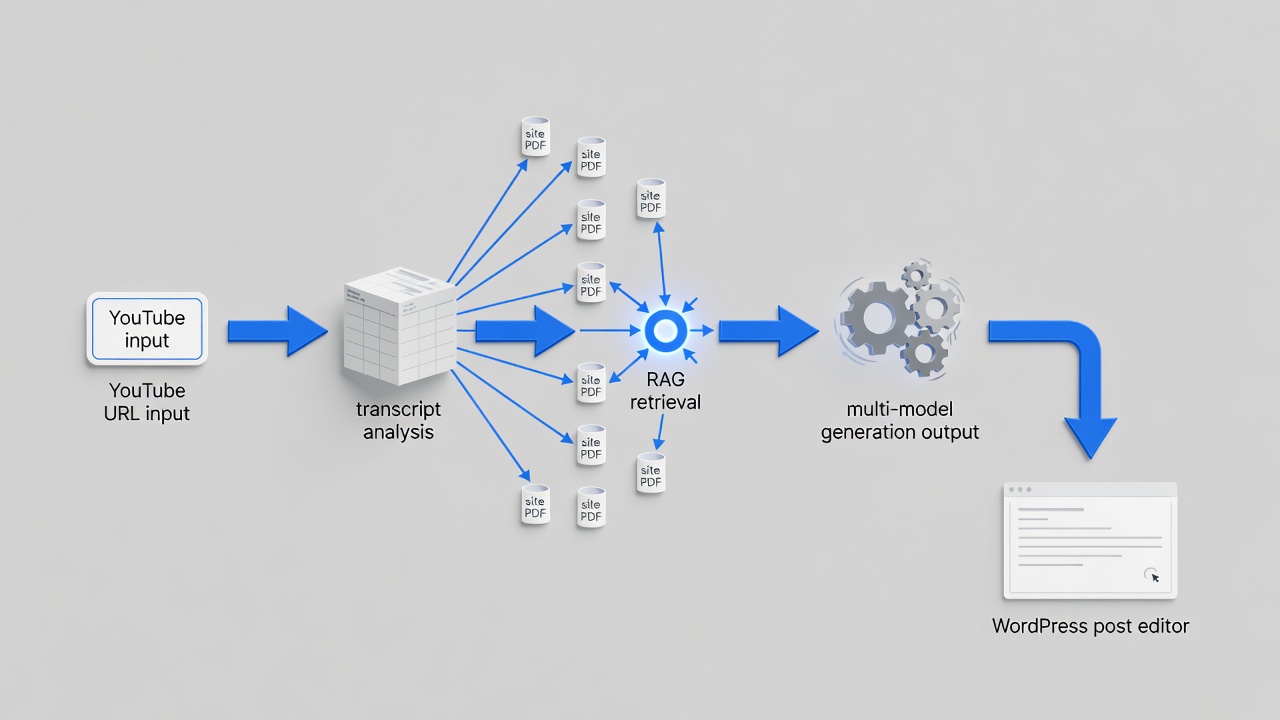
According to industry standards, combining video metadata with site-specific RAG retrieval produces higher engagement rates than text-only generation methods.
Autonomous Content Scheduling with WP-Cron
The WordPress RAG content engine uses the built-in WP-Cron system to execute content strategies on daily, weekly, or monthly intervals. Users define the strategy once and the scheduler handles generation and publishing automatically. This removes the need for manual intervention after initial setup.
Setting Frequency and Volume Limits
Administrators set exact publishing cadences and page volume caps to match server resources and SEO campaign requirements. A common mistake is setting overly aggressive schedules that exceed hosting limits.
Error Handling and Retry Logic
Failed generation attempts trigger automatic retries with logging, ensuring consistent output even during temporary API interruptions. This reliability feature is essential for enterprise deployments running continuous campaigns.
Enterprise Silo Mapping and Directory Structures
| Component | Function | Supported Models |
|---|---|---|
| RAG Retriever | Scans PDFs and pages | All three LLMs |
| Scheduler | WP-Cron publishing | All three LLMs |
| Silo Mapper | Parent-child directories | All three LLMs |
The WordPress RAG content engine maps complex parent-child silos and builds targeted landing grids at enterprise capacity while remaining lightweight through AJAX and WP-Cron synchronization.
Ready to automate your WordPress programmatic pages with a production RAG engine?
Frequently Asked Questions
How does RAG ensure factual accuracy in generated pages?
Retrieval-Augmented Generation grounds every output in your site’s scanned PDFs, pages, and images before any LLM processes the request.
What languages does the WordPress RAG content engine support?
The engine supports over 40 global languages with precise audience level and tone controls ranging from casual to formal.
Can the engine handle custom post type silos?
Yes, the WordPress RAG content engine maps complex parent-child directory structures and builds targeted landing grids for enterprise-scale deployments.
Connect with a specialist for wordpress rag content engine for programmatic pages here.
Related resources: Home – Best AI SEO & GEO WordPress Plugin for 2026 · Blog · Offerings
