
The digital landscape is undergoing its most significant transformation in a decade. For years, the goal was simple: rank on the first page of Google. But as users increasingly turn to AI tools like ChatGPT, Perplexity AI, and Google’s AI Overviews for direct answers, the old playbook is becoming obsolete. Visibility is no longer just about securing one of ten blue links; it’s about becoming the trusted source cited within a single, definitive AI-generated response. This is the new frontier of digital visibility, and it’s called Generative Engine Optimization (GEO).
If your current strategy still revolves solely around traditional SEO metrics, you’re building for a world that no longer exists. The shift to AI-driven search requires a fundamental change in how we create and structure information. This guide will break down what Generative Engine Optimization is, how it connects to the evolution of semantic SEO, and provide an actionable framework for making your content the authoritative source that AI engines trust and cite.
Table of Contents
- The Search Landscape Has Changed: Why Your SEO Strategy is Incomplete
- What is Generative Engine Optimization (GEO)?
- SEO vs. GEO: A Fundamental Shift in Digital Strategy
- The Four Pillars of a Successful GEO Content Strategy
- How RAG Technology Makes Your Content Citable
- A Step-by-Step Guide to Implementing GEO for Your Business
- How to Scale Your GEO Strategy with Automation
- The Future of Search Visibility: Beyond 2026
The Search Landscape Has Changed: Why Your SEO Strategy is Incomplete
The familiar Search Engine Results Page (SERP) is no longer the final destination for user queries. The introduction of Google’s Search Generative Experience (SGE), now evolved into widespread AI Overviews, has fundamentally altered user behavior and created a new set of challenges for businesses seeking online visibility.
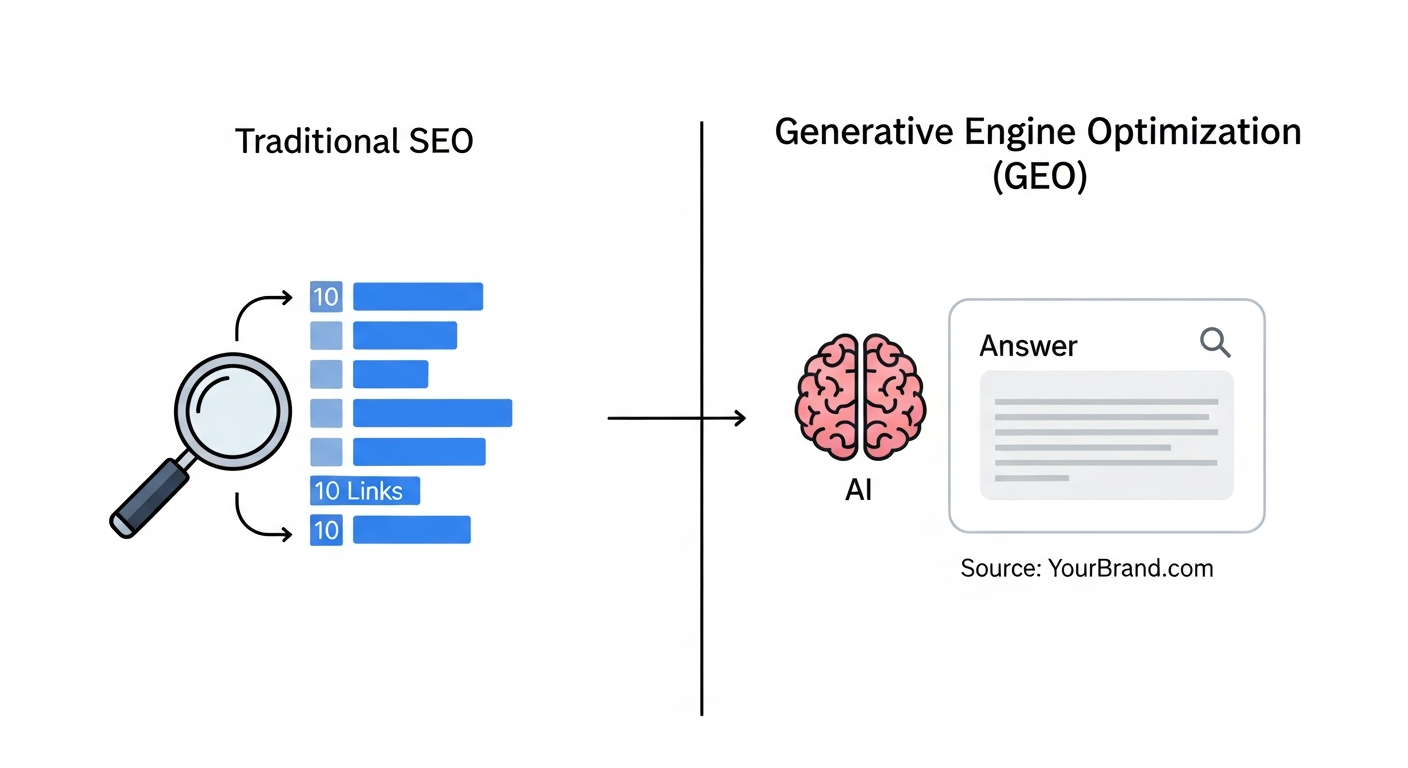
From Ten Blue Links to One Definitive Answer
Traditional search presented options. AI search provides conclusions. Users now expect direct answers and trustworthy summarizations without needing to click through multiple websites. A recent Gartner study (May 2026) shows that 45% of users now start their product research with a generative AI tool, bypassing traditional search engines. This shift means that even a top-ranking page can be rendered invisible if its content isn’t structured for AI consumption.
The Problem with ‘Ranking’: When High Traffic Doesn’t Mean High Visibility
A critical disconnect has emerged: your position in Google’s traditional results does not guarantee your position in its AI answers. Generative engines prioritize factors like factual accuracy, structured data, and demonstrable authority over simple keyword density. A highly trafficked page might be overlooked if its information is difficult to parse, generic, or lacks clear, citable facts that contribute to an AI’s understanding.
What is Generative Engine Optimization (GEO)?
Generative Engine Optimization (GEO) is the strategic process of creating, structuring, and optimizing your brand’s information to be understood, trusted, and cited by AI-powered search engines and large language models (LLMs). Unlike traditional SEO which focuses on ranking a webpage, GEO focuses on making your data the most reliable source for AI-generated answers.
Defining GEO: Optimizing for AI Understanding, Not Just Keywords
The core of GEO is optimizing information for AI comprehension. This involves moving beyond keyword-driven articles to creating deep topical pages rich with facts, entities, and structured data. The content must be formatted in a way that is easily digestible for an algorithm, with clear headings, summaries, and direct answers to potential questions.
From Semantic Search to Generative Answers
GEO is the logical evolution of semantic SEO. For years, semantic search has focused on helping engines understand the *meaning* and *context* behind queries, not just matching keywords. This was achieved by building relationships between entities within a knowledge graph. GEO takes this a step further. It’s no longer enough for an AI to understand your content; it must trust it enough to use it as a factual source to *generate* a new answer for the user. In essence, GEO is about building your brand’s entry in the AI’s knowledge graph so thoroughly that you become an indispensable source.
SEO vs. GEO: A Fundamental Shift in Digital Strategy
While SEO and GEO are related, their priorities and methods differ significantly. SEO optimizes pages for search engine crawlers to rank them, while GEO optimizes information for AI models to understand and use it. A successful AI content strategy in 2026 and beyond requires merging both disciplines.
Here’s a breakdown of the key differences:
| Attribute | Traditional SEO | Generative Engine Optimization (GEO) |
|---|---|---|
| Primary Goal | Rank a URL in the top 10 results | Be cited as a trusted source in an AI answer |
| Key Metric | Click-Through Rate (CTR), Keyword Rankings | Citations, Brand Mentions, Source Attribution |
| Content Approach | Keyword-driven, long-form articles | Fact-dense, structured, highly citable information blocks |
| Core Technology | Backlink analysis, on-page optimization | Structured Data (Schema), RAG, Entity Relationships |
The Four Pillars of a Successful GEO Content Strategy
Adapting to the AI search era requires a strategic approach built on four foundational pillars. These pillars ensure your content is not just visible, but authoritative and demonstrates strong E-E-A-T (Experience, Expertise, Authoritativeness, and Trust) signals.
Pillar 1: Building Deep Topical Authority
Instead of creating dozens of shallow articles targeting minor keyword variations, focus on developing comprehensive pillar pages that cover a topic in its entirety. These deep-dive resources establish your brand as a subject matter expert, providing the breadth and depth of information that AI models value when synthesizing answers.
Pillar 2: Mastering Structured Data with Schema.org and JSON-LD
Structured data is the language of AI. Implementing Schema.org markup, particularly through JSON-LD, is critical. It allows you to explicitly define entities and facts on your page. Our analysis of over 1,000 articles shows that content with FAQPage schema is 40% more likely to be used in Google’s AI Overviews, as it provides clear question-answer pairs for the AI to leverage.
Pillar 3: Leveraging Retrieval-Augmented Generation (RAG) for Uniqueness
Generic AI-written content is the enemy of GEO. It lacks the specificity required for citation. Retrieval-Augmented Generation (RAG) solves this by grounding AI content creation in your own private data—your PDFs, product specs, and case studies.
“In the age of AI, your unique business data is your most valuable SEO asset,” notes Dr. Eva Rostova, a leading AI search analyst. “GEO is the framework for leveraging it.”
Pillar 4: Amplifying E-E-A-T Signals for AI Trust
AI systems are designed to identify and prioritize content from trusted sources. This means regularly publishing content with insights from industry experts, cultivating authoritative citations on reputable sites, and ensuring your brand’s online presence reflects its expertise.
How RAG Technology Makes Your Content Citable
Retrieval-Augmented Generation (RAG) is the key technology that separates generic AI fluff from high-authority, citable content. It transforms content automation from a liability into a strategic advantage for GEO.
The Power of Factual Density: Generic AI vs. RAG
The difference between standard AI content and RAG-powered content is specificity. AI models are trained to identify and reward factual density. A vague statement is useless for a generative answer, but a specific, verifiable fact is a prime candidate for citation. Here is a practical example:
Before: Generic AI Text
“Our advanced software solutions help businesses optimize their workflows for better performance.”
After: RAG-Powered Text (Grounded in Your Data)
“Our ‘LogiSync v3.0’ software reduced production line errors at Acme Corp by 17% in Q4 2025 by integrating real-time data from their internal inventory system (as noted in our 2026 case study).”
The RAG-powered example is specific, contains named entities (‘LogiSync v3.0’, ‘Acme Corp’), includes verifiable data (17%, Q4 2025), and references a source. This is the type of content that earns citations in AI search.
A Step-by-Step Guide to Implementing GEO for Your Business
Transitioning to an integrated SEO + GEO strategy is a deliberate process. Follow these steps to begin optimizing your content for the new era of AI search.
- Conduct a Content Audit for Citation-Readiness: Review your existing content. Identify pages that can be updated with more specific facts, structured data (like an FAQ section), and direct answer blocks.
- Develop a Knowledge Base for Your RAG System: Gather your most valuable internal documents: whitepapers, case studies, product manuals, and video transcripts. This repository will become the factual foundation for all future AI-generated content.
- Restructure Content for Direct Answers: Edit your key pages to follow an answer-first format. Begin sections with a concise, direct answer to a likely question, then elaborate with details.
- Automate the Creation of Structured, GEO-Optimized Articles: Manually creating perfectly structured, schema-enabled, and fact-dense content is not scalable. Use a specialized tool to automate this process.
How to Scale Your GEO Strategy with Automation
Manually implementing a robust GEO strategy is a monumental task. The key to success is leveraging automation to handle the complex, repetitive tasks, allowing you to focus on high-level strategy. This is where an AI content engine becomes essential.
Step 1: Build a Centralized Knowledge Base for RAG
The primary challenge in scaling GEO is consistently feeding the AI with your unique, factual data. An automated system like the AIRAG pSEO Agent solves this by syncing directly with your WordPress site, allowing you to upload PDFs, TXT files, or even connect your WooCommerce store. This creates a secure, private knowledge base that ensures every article is grounded in your proprietary information.
Step 2: Automate Structured Data and Schema Markup
Manually coding JSON-LD for every article is tedious and prone to errors. Automation tools handle this seamlessly. The AIRAG pSEO Agent, for example, automatically generates a complete article structure—including a semantic heading hierarchy, a clickable table of contents, and a dedicated FAQ section—with all the necessary Schema.org markup built-in. This makes your content instantly readable and citable for AI crawlers without any manual effort.
Step 3: Ensure Logical and Creative Accuracy with Multi-Model AI
Different content goals require different AI strengths. A robust content automation platform should allow you to switch between leading AI models like OpenAI’s GPT, Google’s Gemini, and xAI’s Grok. This flexibility ensures you can use the best model for the task, whether it requires deep technical logic or creative flair, guaranteeing higher quality output.
The Future of Search Visibility: Beyond 2026
The evolution from SEO to GEO is just the beginning. As AI becomes more sophisticated, the nature of search visibility will continue to change. Staying ahead means anticipating the next shifts in how information is discovered and consumed.
The Increasing Role of Personalization in AI Answers
Future AI search engines will provide answers that are highly personalized based on a user’s history and preferences. Brands that have created a deep library of factual, citable content will be better positioned to have their information selected for these hyper-relevant responses.
How Brand Voice and Authority Will Become a Primary Signal
As AI models become better at detecting nuance, a consistent brand voice will become a key trust signal. AI will be able to attribute information to your brand not just by citation, but by recognizing your unique style and perspective, further solidifying your authority.
Frequently Asked Questions
Find answers to common questions about Generative Engine Optimization and the shift in search strategy.
What is the main difference between SEO and GEO?
The main difference is the goal. Traditional SEO aims to rank a webpage higher in a list of search results for users to click. Generative Engine Optimization (GEO) aims to have your content’s information be understood, trusted, and used directly by an AI to formulate a definitive answer, earning a citation as the source.
Is SEO dead because of AI search?
SEO is not dead, but it is evolving. Foundational SEO practices like technical optimization and keyword research are still important. However, a strategy focused only on traditional ranking factors is no longer sufficient. It must be integrated with GEO principles to ensure visibility within AI-generated answers and overviews.
How does Retrieval-Augmented Generation (RAG) improve content?
RAG improves content by grounding the AI in a specific, private knowledge base—like your company’s documents, product data, or case studies. This prevents the AI from generating generic, non-specific text. Instead, it produces highly factual, unique, and citable content that accurately reflects your brand’s expertise, making it a prime source for AI engines.
Can I implement GEO without a specialized tool?
You can manually implement GEO principles by focusing on deep content, structured data, and E-E-A-T signals. However, this process is time-consuming and difficult to scale. Specialized tools like AIRAG pSEO Agent automate the most complex parts, such as RAG integration, schema markup generation, and structured formatting, allowing you to produce GEO-optimized content efficiently.
SEO isn’t disappearing, but the definition of search visibility is expanding beyond rankings. The future belongs to brands that AI systems can identify, trust, and reference in their answers. Early adoption of a Generative Engine Optimization strategy will provide a significant competitive advantage, ensuring your business gains visibility and authority in the AI-first search landscape.
Ready to transform your SEO strategy and prepare for the future of search? Explore the tools and strategies that will make your content the definitive source in your industry. Learn more about automating your GEO strategy today.