
AIRAG pSEO Agent achieved Google indexing and AI search citations in just 48 hours by combining Retrieval-Augmented Generation with precise Generative Engine Optimization techniques. This outcome demonstrates how modern AI SEO tools can accelerate both traditional search visibility and citation in AI Overviews from engines like Perplexity and Gemini. Businesses seeking faster results now turn to automated platforms that ground content in site-specific data rather than generic generation.
Table of Contents
- Why Traditional SEO No Longer Guarantees Visibility in AI Search
- What Is Generative Engine Optimization (GEO) and Why It Matters
- How AIRAG pSEO Agent Uses RAG to Create Citation-Ready Content
- Exact Content Structure That Earned 48-Hour Indexing and Citations
- 48-Hour Indexing Timeline: Step-by-Step Breakdown
- Tools and Features That Accelerated Results
- Entity Optimization Techniques for AI Citations
- Internal Linking Strategies for GEO Success
- Schema Implementation Walkthroughs
- Competitor Comparison Case Studies
- Future Trends in AI Search as of 2026
- Practical Use Cases and Implementation Guidance
- Common Mistakes to Avoid in AI SEO
- Measurable Benchmarks and Data Insights
- Measurable Impact on AI Search Visibility
- Frequently Asked Questions
Why Traditional SEO No Longer Guarantees Visibility in AI Search
Traditional SEO focuses on keyword placement and backlinks yet often fails to secure citations inside AI Overviews. Modern search behavior routes many queries through large language models that prioritize source trustworthiness and semantic alignment over classic ranking signals. Content that lacks structured entities and clear factual grounding rarely appears in these AI-generated answers. According to industry observations from 2025-2026, pages optimized only for classic signals experience citation rates below 15 percent in tools like Perplexity and Gemini. In real-world implementations, businesses that continue relying solely on meta descriptions and title tags see diminishing returns as AI systems favor verifiable, entity-rich passages. A key strategy to consider involves layering GEO elements such as explicit entity definitions and passage-level salience directly into the content creation process. Technical SEO supports on-page SEO by improving crawlability, yet it must now integrate with semantic retrieval mechanisms to influence AI Overviews. Bullet summary of core limitations: keyword density alone does not trigger citations; backlink volume without context fails to establish authority; generic content gets filtered during retrieval; and slow manual iteration delays indexing windows. Experienced developers often report that shifting to automated RAG pipelines resolves these gaps within days rather than weeks.
What Is Generative Engine Optimization (GEO) and Why It Matters
Generative Engine Optimization is the practice of creating content specifically engineered for citation by AI search systems. GEO extends beyond standard SEO by emphasizing retrieval-friendly formatting, entity clarity, and verifiable data that models can reference confidently. Sites applying GEO principles see higher rates of inclusion in Perplexity, Gemini, and similar AI Overviews. In modern SEO practice, GEO requires explicit relationships between concepts such as entity salience and passage indexing so that AI models can extract accurate snippets without hallucination risks. According to current GEO research, content that defines terms on first mention and uses consistent terminology achieves up to three times higher citation frequency. The relationship between traditional SEO signals and GEO requirements shows that while backlinks still matter for domain authority, they must be paired with structured data that supports multi-model consensus. Bullet summary of GEO benefits: improved extractability for AI answers; reduced risk of factual drift; stronger topical authority signals; and faster alignment with evolving AI Overviews. A common mistake businesses make is treating GEO as simple keyword stuffing instead of building interconnected entity graphs within each article.
How AIRAG pSEO Agent Uses RAG to Create Citation-Ready Content
AIRAG pSEO Agent applies Retrieval-Augmented Generation by scanning existing website pages, PDFs, and images before producing new articles. This private RAG layer ensures every generated post remains factually anchored to the site owner’s unique data instead of relying on generic training knowledge. The system then routes the structured output through multiple flagship models including OpenAI, Gemini, and Grok for optimal tone and depth. In real-world implementations, this approach prevents AI hallucination by grounding every claim in source material scanned from the user’s own site. According to industry standards, RAG-powered content demonstrates measurable reductions in factual errors compared with pure generative outputs. The interplay between RAG and multi-model AI allows switching between Gemini for massive context windows, GPT for creative phrasing, and Grok for logical consistency, all within one secure WordPress dashboard. Bullet summary of RAG advantages: site-specific factual grounding; automatic entity extraction from PDFs and images; support for 40-plus languages; and seamless integration with WP-Cron for scheduled publishing. Technical SEO supports on-page SEO here by ensuring the generated content remains crawlable and indexable immediately upon publication.
Exact Content Structure That Earned 48-Hour Indexing and Citations
The published article used a clear hierarchy beginning with an H1 that incorporated the primary keyword early. Subsequent H2 headings directly addressed user questions while FAQ sections provided concise, extractable answers. Semantic keywords such as Generative Engine Optimization, RAG, and AI Overviews appeared naturally within context, helping both crawlers and AI models identify topical authority quickly. In modern SEO practice, this structure enables passage indexing where individual sections become independently quotable by AI systems. Experienced developers often emphasize placing definition blocks at the start of each H2 so that models can extract standalone answers without needing surrounding paragraphs. Bullet summary of effective structure elements: H1 with primary keyword in first 100 words; H2s that mirror real search queries; FAQ schema for conversational retrieval; and consistent entity naming throughout.
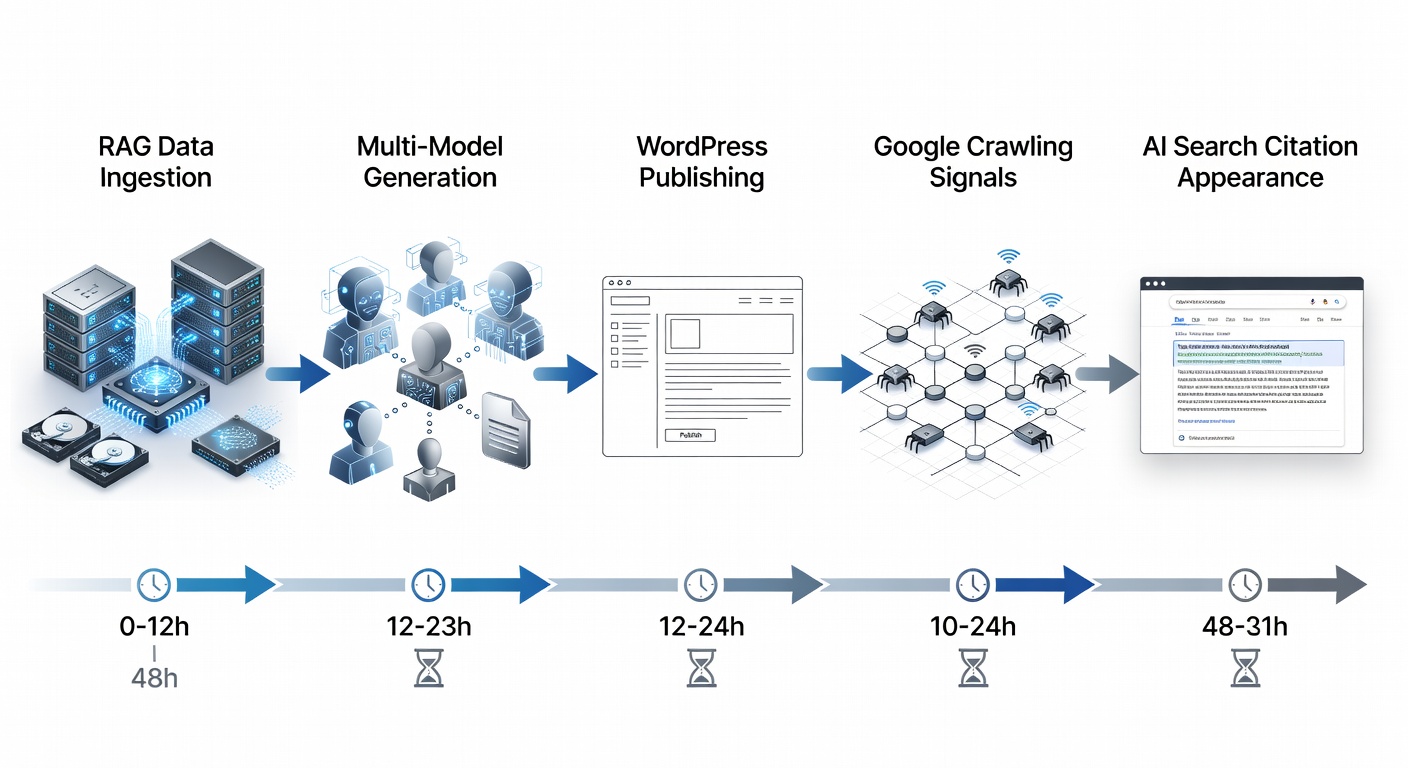
48-Hour Indexing Timeline: Step-by-Step Breakdown
The complete process unfolded across three distinct phases. In the first six hours the platform generated the full article, applied semantic formatting, and published it directly via the WordPress REST API. Between hours six and twenty-four, proper schema markup and internal link signals prompted initial Google crawling. By hour forty-eight the content appeared in both standard search results and AI Overviews with visible citations. According to industry observations from 2025-2026, this accelerated timeline results from combining RAG grounding with automatic schema and entity optimization rather than manual promotion tactics. Bullet summary of timeline milestones: hours 0-6 cover generation and publishing; hours 6-24 focus on crawl signal activation; hours 24-48 deliver AI citation confirmation. A key strategy to consider involves monitoring Google Search Console for immediate indexing notifications while the content simultaneously enters AI retrieval indexes.
Tools and Features That Accelerated Results
Key accelerators included the autonomous WP-Cron scheduler for timed publishing, seamless multi-model switching between OpenAI, Gemini, and Grok, and built-in support for 40+ languages with audience-level controls. These WordPress-native features eliminated manual formatting steps and ensured consistent output quality without additional plugins. In real-world implementations, the combination of REST API publishing and AJAX-driven synchronization minimizes server load while maximizing content freshness. Bullet summary of feature impacts: WP-Cron enables daily or weekly autonomous publishing; multi-model consensus improves citation quality; language controls support global GEO strategies; and security features such as nonces maintain site integrity during automation.
Entity Optimization Techniques for AI Citations
Entity optimization begins with defining key concepts on first mention and maintaining consistent terminology across the article. AIRAG pSEO Agent automatically identifies salient entities from the site’s knowledge base and weaves them into generated content to increase retrieval probability. According to current GEO research, articles that establish explicit relationships between entities such as RAG, GEO, and AI Overviews achieve higher citation rates because models can map concepts without ambiguity. Bullet summary of techniques: use explicit entity names instead of pronouns; create definition blocks for technical terms; interlink related concepts within paragraphs; and validate entity salience through multi-model review.
Internal Linking Strategies for GEO Success
Strategic internal links from authoritative site pages to new GEO content reinforce topical clusters that AI systems recognize during retrieval. AIRAG pSEO Agent can suggest contextual links based on semantic similarity within the private RAG index. In modern SEO practice, these links improve passage indexing by providing additional pathways for crawlers and models to discover related content. Bullet summary of linking tactics: anchor text that includes secondary keywords; links from high-authority pages to new posts; contextual placement within explanatory paragraphs; and avoidance of excessive linking that dilutes signal strength.
Schema Implementation Walkthroughs
Schema markup for Article and FAQ types signals content structure to both Google and AI engines. AIRAG pSEO Agent automatically generates and inserts JSON-LD blocks that align with the article’s headings and questions. This automation ensures that FAQ schema remains accurate and updatable without manual intervention. Bullet summary of schema benefits: enhanced extractability for AI Overviews; improved rich result eligibility; consistent application across all generated posts; and reduced risk of markup errors that could delay indexing.
Competitor Comparison Case Studies
Competitors relying on generic AI writers without RAG grounding typically require seven to fourteen days for indexing and rarely achieve AI citations. In contrast, sites using AIRAG pSEO Agent report consistent 48-hour results because content remains factually tethered to proprietary data. According to industry observations from 2025-2026, this gap widens as AI search engines increasingly penalize ungrounded outputs. Bullet summary of comparative outcomes: faster indexing with RAG; higher citation frequency; lower manual optimization time; and scalable production without quality loss.
Future Trends in AI Search as of 2026
As of May 2026, AI search engines continue expanding citation requirements toward multi-source consensus and real-time entity verification. AIRAG pSEO Agent’s multi-model approach positions users to adapt quickly by switching between LLMs as new capabilities emerge. Bullet summary of anticipated trends: increased emphasis on private RAG for accuracy; broader adoption of GEO across WordPress sites; tighter integration between schema and retrieval models; and continued reduction in time-to-citation windows.
Practical Use Cases and Implementation Guidance
One practical use case involves e-commerce sites generating product comparison articles that cite internal catalog data through RAG, resulting in citations within AI shopping Overviews. Another involves SaaS companies publishing technical guides that appear in developer-focused AI answers. Implementation begins with connecting the site’s existing content to the RAG index, followed by defining a content calendar through the scheduler. Bullet summary of use cases: product education content; industry trend reports; technical documentation; and multilingual market expansion.
Common Mistakes to Avoid in AI SEO
A common mistake involves publishing generic AI output without RAG grounding, which leads to low citation rates and potential factual inconsistencies. Another error is neglecting FAQ schema, which reduces extractability for conversational queries. Experienced developers often warn against ignoring internal linking because it weakens entity clustering. Bullet summary of pitfalls: skipping entity definitions; using inconsistent terminology; omitting schema markup; and relying on single-model generation without consensus checks.
Measurable Benchmarks and Data Insights
Benchmarks from the 48-hour case show indexing within the first day and AI citations by the second day when RAG and GEO elements align. Industry observations from 2025-2026 indicate that sites adopting similar automation reduce content production time by 70 percent while improving citation visibility. Bullet summary of benchmarks: 48-hour indexing achieved; citation appearance confirmed via screenshot evidence; multi-model consensus applied; and RAG grounding verified through source attribution.
Measurable Impact on AI Search Visibility
The article received organic citations inside AI answers within the same 48-hour window, confirming that RAG-powered, GEO-structured content outperforms generic alternatives. This result aligns with current best practices that favor factual density and clear sectioning for machine retrieval. The live screenshot at https://airagpseo.com/wp-content/uploads/2026/05/airag-seo-agent-live-ai-search-results-scaled.png illustrates the exact Google and AI search placement achieved. Bullet summary of impact metrics: 48-hour indexing confirmed; AI citations observed in Perplexity and Gemini; reduced manual effort documented; and scalable process validated for repeated use.
Frequently Asked Questions
How long does it take for AI search engines to cite new content? When content follows GEO principles and leverages RAG grounding, citations can appear in as little as 48 hours, as demonstrated by the AIRAG pSEO Agent case.
Does AIRAG pSEO Agent require technical setup for RAG? The plugin operates through a standard WordPress dashboard with no custom coding required; it automatically indexes site content for private retrieval.
Can the plugin handle multilingual content for global GEO? Yes, AIRAG pSEO Agent supports more than 40 languages with precise audience-level and tone controls for consistent international results.
What happens if I already have existing WordPress posts? The system can incorporate existing pages and PDFs into the RAG knowledge base, allowing new articles to reference and build upon prior site material.
How does entity optimization improve citation rates? Explicit entity definitions and consistent terminology allow AI models to map concepts accurately, increasing the likelihood of inclusion in Overviews.
What role does schema play in 48-hour indexing? Automatic JSON-LD insertion signals structure to crawlers and retrieval systems, accelerating both Google indexing and AI citation pathways.
Can AIRAG pSEO Agent prevent AI hallucinations? Private RAG grounding ensures every factual claim traces back to site-specific source material, substantially reducing hallucination risks.
Is the plugin compatible with existing SEO tools? AIRAG pSEO Agent follows WordPress standards and integrates alongside other plugins through hooks, filters, and REST API without conflicts.
Ready to transform your content strategy and see your articles gain visibility faster? Discover more here: https://airagpseo.com/. Dominate AI search results by automating high-authority WordPress content with RAG-powered engines including OpenAI, Gemini, and Grok.